
Determine the right cooling capacity for your switchgear cabinet
Control cabinet cooling calculation
The required cooling of a control cabinet depends on heat load, ambient temperature, cabinet layout and desired interior temperature. Kwadrant IA calculates and evaluates the thermal management of industrial switchgear cabinets as part of hardware engineering and panel construction.
OPEN CALCULATION
Transparent cost structure and control of your project.
OFFER IN 5 DAYS
Quick technical assessment and clear planning.
DURABLE CONSTRUCTION
Lower Total Cost of Ownership.
UL/CSA IN-HOUSE
Directly compliant for international markets.

When and why control cabinet cooling is calculated
Control cabinet cooling is calculated to determine how much heat a cabinet must dissipate to keep it functioning reliably. Components such as power supplies, variable speed drives, PLCs, relays, softstarters, protective devices and industrial electronics produce heat during operation. If that heat is not properly dissipated, the temperature inside the cabinet rises.
A calculation is especially important with compact cabinets, high component densities, variable speed drives, sealed enclosures, higher IP classes or hot production environments. Even with existing control cabinets that were later expanded, the original heat management may no longer match the current load.
Kwadrant IA does not see a cooling calculation as a separate step after the fact. The required heat dissipation is part of the cabinet design. Therefore, we look at component data, cabinet layout, air circulation, IP rating, maintainability and the environment in which the system must operate.
Complete automation solutions
We realize control systems from design to delivery. By integrating engineering, panel construction, cabling and commissioning, we ensure quality, efficiency and international deployment.
What factors determine the cooling power required?
The cooling capacity of a control cabinet is determined by the balance between heat generated, heat that the cabinet itself can dissipate, and heat that must be additionally dissipated. So a good calculation starts not with which fan or air conditioner fits, but with the thermal housekeeping of the entire cabinet.
Important factors are:
- the dissipated power of components;
- the desired indoor temperature and maximum ambient temperature;
- the cabinet area, cabinet arrangement and IP rating;
- air circulation and simultaneity of component loads;
- environmental factors such as dust, moisture, oily air and maintainability.
Together, these factors determine whether passive heat dissipation is sufficient, or whether additional switchgear cooling is required with ventilation, a heat exchanger, air conditioner or cooling unit.
In practice, this is rarely a standard choice. A compact control cabinet with frequency converters requires a different assessment than a larger distribution cabinet with limited heat load. And a cabinet in a clean technical room requires a different solution than an IP65 cabinet in a dusty or humid production environment.
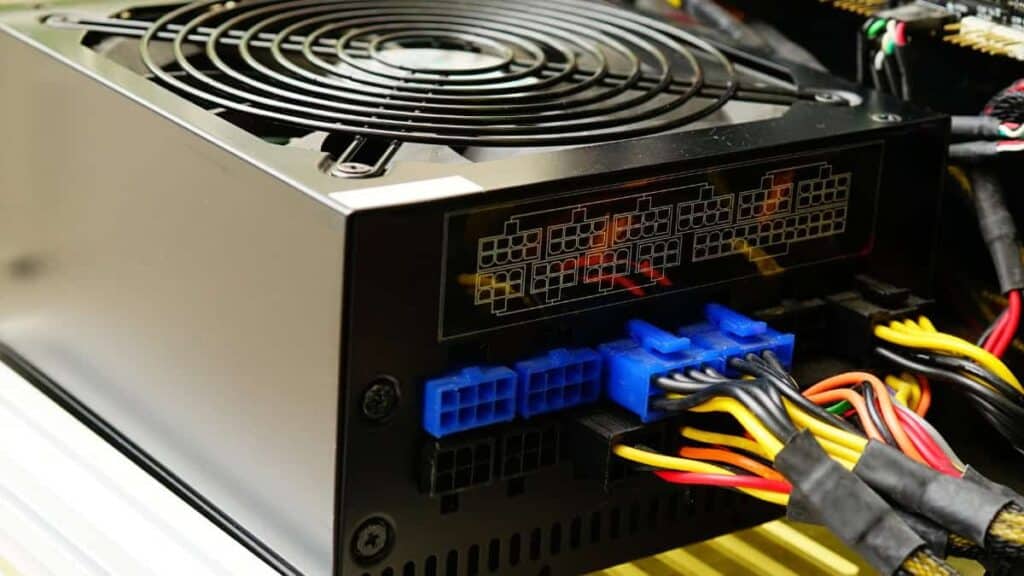
Technology behind the calculation of switchgear cooling
Heat load and dissipated power
The calculation begins with the heat load in the cabinet. Each electrical component converts some of its absorbed energy into heat. This is also called dissipated power and is usually expressed in watts.
Typical heat sources in a control cabinet are variable speed drives, power supplies, transformers, softstarters, power components, industrial computers, network equipment and protection devices. Drives and power electronics in particular can have a major impact on cabinet temperatures.
A good heat calculation involves looking at component data sheets and power losses. Not every component runs continuously at maximum load. Therefore, concurrency is also important: which components are active at the same time, how long do they run under load, and what is the worst-case situation?
A common mistake is to make the cabinet size leading. But a large cabinet with few heat-producing components can be thermally simpler than a compact cabinet with multiple variable speed drives. So the calculation starts with what goes on inside the cabinet, not with the outside dimensions of the cabinet.
Cabinet area, arrangement and heat output
A switchgear cabinet can dissipate heat passively through the enclosure. This is done through conduction, convection and radiation. How much heat can be dissipated in this way depends on the effective enclosure surface area, the enclosure material, and the way the enclosure is placed.
A freestanding cabinet can dissipate heat better than one that stands against a wall, is arranged in a row or is built into a niche. The space around the cabinet also plays a role. If warm air cannot flow away properly, natural heat dissipation decreases.
In panel construction, this is an important practical point. On paper, a cabinet may have sufficient surface area, but in installation it may turn out differently. Consider a cabinet that is close to a machine frame, placed next to a heat source or has barely any free space on the sides.
The IP rating also affects the options. A cabinet with vents can dissipate heat more easily, but may not be suitable in dusty, humid or cleanable environments. A closed cabinet protects components better, but also retains heat more easily.
Therefore, the cabinet arrangement should always be part of the calculation. Not only do the dimensions on paper count, but also the actual mounting position in the installation.
Indoor and ambient temperature
One of the most important parts of the calculation is the difference between the desired indoor temperature and the maximum ambient temperature. The indoor temperature must match the components being used. PLCs, power supplies, variable speed drives and other electronics all have a temperature range within which they operate reliably.
The ambient temperature determines how much heat the cabinet can still dissipate. If the cabinet is located in a cool technical room, passive heat dissipation or ventilation is more likely to be sufficient. If the cabinet is in a hot factory hall, outside in the sun or next to process heat, the cooling demand increases.
Ventilation works well only when the ambient air is cooler than the desired cabinet temperature. If the outside air is already too warm, then a fan mainly moves warm air. In that case, active cooling with a cooling unit or air conditioner is often necessary.
Temperature fluctuations are also important. A cabinet that heats up during the day and cools sharply at night may be prone to condensation. Then the calculation is not only about cooling, but also about moisture control, cabinet heating and sealing. You can read more about this on the page preventing condensation in switchgear.
Ventilation, heat exchanger or cooling unit
After determining the heat load, the next step is to choose the right cooling solution. That choice depends on the required heat dissipation, the environment and the requirements of the control cabinet.
With limited heat loads and clean, cooler ambient air, ventilation may be sufficient. A fan or filter fan exhausts warm air and brings cooler air into the cabinet. This is relatively simple, but requires filter maintenance and airflow control.
When cabinet air and outside air must remain separate, an air-to-air heat exchanger or air-to-water heat exchanger may be a better choice. This is especially relevant in environments with dust, dirt, moisture or oily air.
With higher heat loads or high ambient temperatures, a chiller unit or air conditioner is often needed. A chiller unit uses an active cooling process with compressor to remove heat from the cabinet. This can lower the interior temperature even when ventilation is inadequate.
There are also specialized solutions, such as Peltier elements or Vortex cooling. These can be useful in specific applications, but are not automatically the standard choice for industrial switchgear cooling. The right choice always depends on heat load, environment, IP class, maintenance and operational reliability.
Are you unsure between ventilation, heat exchanger or air conditioning? On the air conditioning vs ventilation switchboard page, we explain when which solution is appropriate. For applications requiring active cooling, a cooling unit panel may be an appropriate solution.
Why a rule of thumb is not enough
In practice, choices are sometimes made based on experience or a simple rule of thumb. For example, “we install a filter fan” or “we choose a cooling unit with some extra capacity.” This seems practical, but can be technically wrong.
Too little cooling power leads to excessive cabinet temperatures, malfunctions and accelerated component aging. Too much cooling power is also not ideal. An oversized cooling solution uses energy unnecessarily, takes up space and can contribute to condensation problems if improperly controlled.
A rule of thumb often does not take sufficient account of actual practice:
- a cabinet may have been later expanded with additional components;
- a variable speed drive may be loaded more heavily than originally anticipated;
- filters can contaminate and restrict airflow;
- the cabinet may be closer to a heat source than shown on drawing;
- a high IP rating can restrict ventilation;
- ambient temperature may be higher than expected in summer;
- maintenance on fans or filters can be difficult to access in practice.
Especially in industrial plants, these are not details. The control cabinet is part of a machine, production line or process plant. If the temperature management is incorrect, it can lead to malfunctions, downtime and lost productivity.
Therefore, an engineering assessment is more important than a quick estimate. The cooling solution must fit the cabinet, the components, the environment and the reliability required by the process.
From calculation to practical cabinet design
A cooling calculation is not valuable until it is translated into a feasible cabinet design. The calculated cooling capacity says how much heat must be dissipated, but practicality determines how best to do that.
When translating to panel construction, we consider, among other things, the placement of heat-producing components, the route of hot and cold air flows, the position of fans or cooling units and accessibility for maintenance. Cable trays, mounting plates and component spacing also affect air circulation in the cabinet.
This is especially important with compact control cabinets. A cooling unit may have sufficient capacity, but if air flows are blocked or heat builds up around variable speed drives, the cabinet remains thermally vulnerable.
That is why Kwadrant IA always links calculation to practical implementation. The solution must not only be correct in theory, but also work in the cabinet as it is built, installed and maintained.
How Kwadrant IA helps calculate control cabinet cooling
At Kwadrant IA, we approach switchgear cooling as part of the complete control system. It’s not just about choosing a fan, heat exchanger or cooling unit. The cooling solution must fit the components, cabinet layout, IP rating and practical environment.
We assess component heat generation, cabinet layout, available space, air circulation, maximum ambient temperature and maintainability requirements, among other factors. We also consider energy consumption, future expansion and how the cabinet is placed in the installation.
For new control cabinets, we incorporate these factors directly into hardware engineering, EPLAN design and panel construction. For existing cabinets, we can assess why temperatures are rising and what adjustment makes technical sense.
Kwadrant IA can support:
- Determining the heat load in the control cabinet;
- calculating required cooling capacity;
- Assess cabinet area, arrangement and IP rating;
- Analyzing component layout and air circulation;
- choice between passive heat dissipation, ventilation, heat exchanger or active cooling;
- integration of fans, filters, air conditioners or cooling units;
- Prevention of condensation and maintenance problems;
- Realize reliable panel construction for industrial applications.
Want to know for sure what cooling capacity your control cabinet needs? Kwadrant IA assesses the heat load, cabinet layout and environmental conditions and translates this into a practical cooling solution.
Discuss your switchgear with a specialist.
Start your project with a technical consultation
We like to think with you from the initial design phase to realization and commissioning.
Related articles
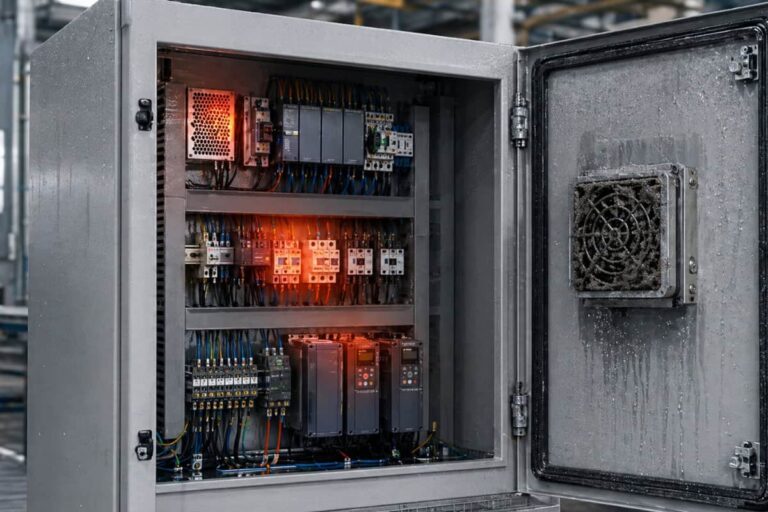
IP65 ventilation problem in control cabinets
An IP65 control cabinet is chosen to protect components from dust and water. This is important in industrial environments, production
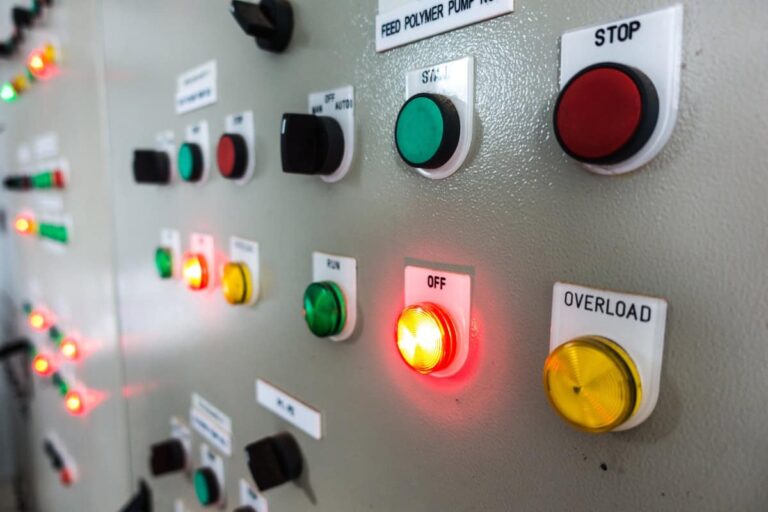
When do you need cooling in a control cabinet?
A control cabinet always develops heat. That happens from components such as power supplies, PLCs, variable speed drives, relays, contactors,
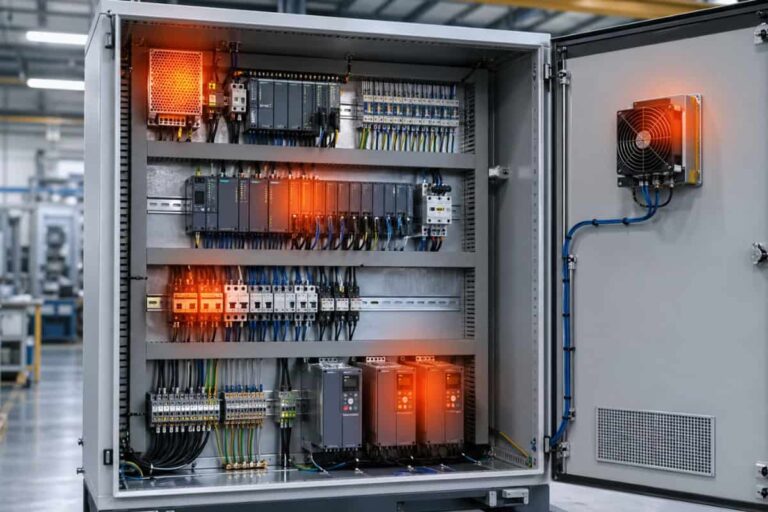
5 causes of overheating in electrical cabinets
A control cabinet that gets too hot has usually been giving signals for some time. An inverter occasionally fails. A
Frequently asked questions about Control cabinet cooling calculation
How do you calculate the cooling capacity of a control cabinet?
The cooling capacity is determined based on the heat load of components, the cabinet area, the desired interior temperature, the maximum ambient temperature and the cabinet arrangement. IP class, air circulation and environmental factors also play a role.
Which components cause the most heat?
Especially variable speed drives, power supplies, transformers, softstarters, power components, industrial computers and network equipment produce a lot of loss heat. The exact heat load depends on the type of component and the load during operation.
When is a fan sufficient?
A fan is sufficient when the heat load is limited and the ambient air is cooler and clean enough to dissipate heat. In dusty, humid or hot environments, ventilation is not always appropriate.
When is a cooling unit needed?
A cooling unit is needed when ventilation or passive heat dissipation is insufficient. This plays out, for example, in high ambient temperatures, closed cabinets, high IP requirements or high component loads.
Why should overdimensioning be avoided?
An oversized cooling solution uses unnecessary energy, takes up more space and can contribute to condensation problems if used incorrectly. Therefore, the cooling solution must fit the actual heat load and operating conditions.
