
Protect components from moisture, corrosion and failure
Preventing condensation in control cabinet
Condensation is caused by temperature differences and humidity. In control cabinets, this can lead to corrosion, leakage currents, short circuits and failure of electronic components. Condensation prevention therefore requires more than just a waterproof enclosure.
OPEN CALCULATION
Transparent cost structure and control of your project.
OFFER IN 5 DAYS
Quick technical assessment and clear planning.
DURABLE CONSTRUCTION
Lower Total Cost of Ownership.
UL/CSA IN-HOUSE
Directly compliant for international markets.
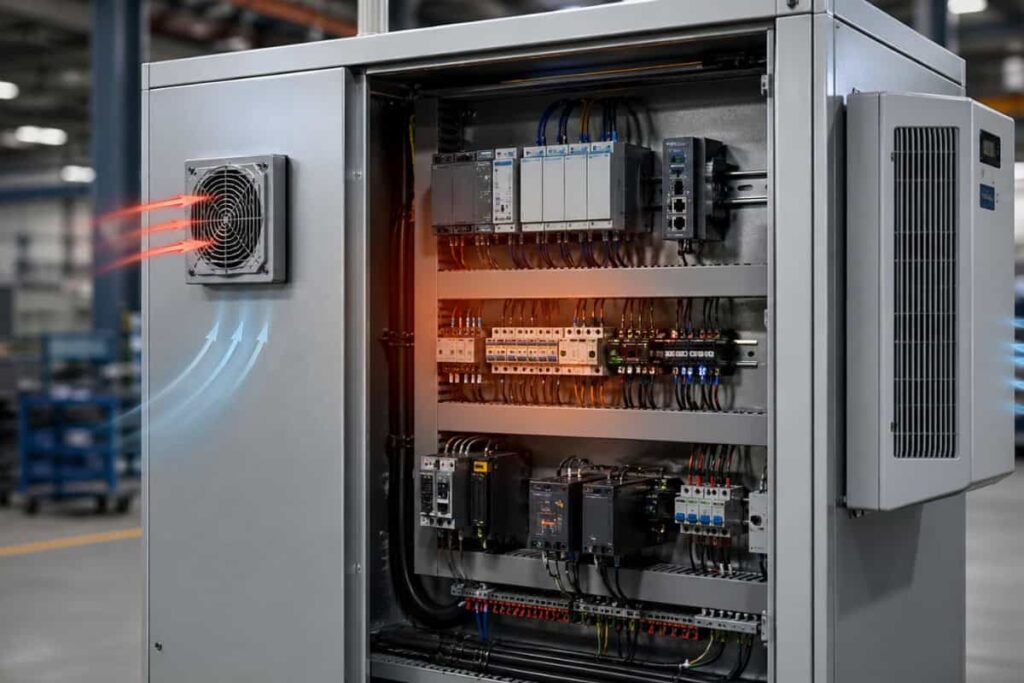
When and why condensation forms in switchgear cabinets
Condensation occurs when moist air in the control cabinet cools below the dew point. The water vapor in the air then settles on cold surfaces, such as mounting plates, enclosure walls, terminals, circuit boards or electrical connections.
This is especially an issue with outdoor control cabinets, cabinets in damp production areas, installations with strong temperature differences or control cabinets that are not in continuous operation. Even a closed cabinet with a high IP rating can develop condensation problems once moisture is present in the cabinet and not properly dissipated.
Kwadrant IA evaluates condensation prevention as part of the overall climate control of the control cabinet. Here, we look at heat generation, cooling, ventilation, cabinet heating, sealing, IP rating and the environment in which the installation must operate.
Complete automation solutions
We realize control systems from design to delivery. By integrating engineering, panel construction, cabling and commissioning, we ensure quality, efficiency and international deployment.
What factors determine the risk of condensation?
The risk of condensation is determined by the combination of temperature, humidity and cabinet construction. A condensation problem rarely arises from one factor. It often involves an interplay of humid air, cooling, sealed enclosure and inadequate control.
Important factors are:
- difference between cabinet temperature and ambient temperature;
- relative humidity and dew point;
- IP class, sealing and pressure differentials;
- ventilation, cooling, closet heating and control;
- outdoor installation, cleaning, dust or humid environment.
Condensation prevention thus requires a balance between sealing, temperature control and controlled airflow. A cabinet must be protected from outside dust and moisture, but must not have an internal climate where moisture can precipitate on components.
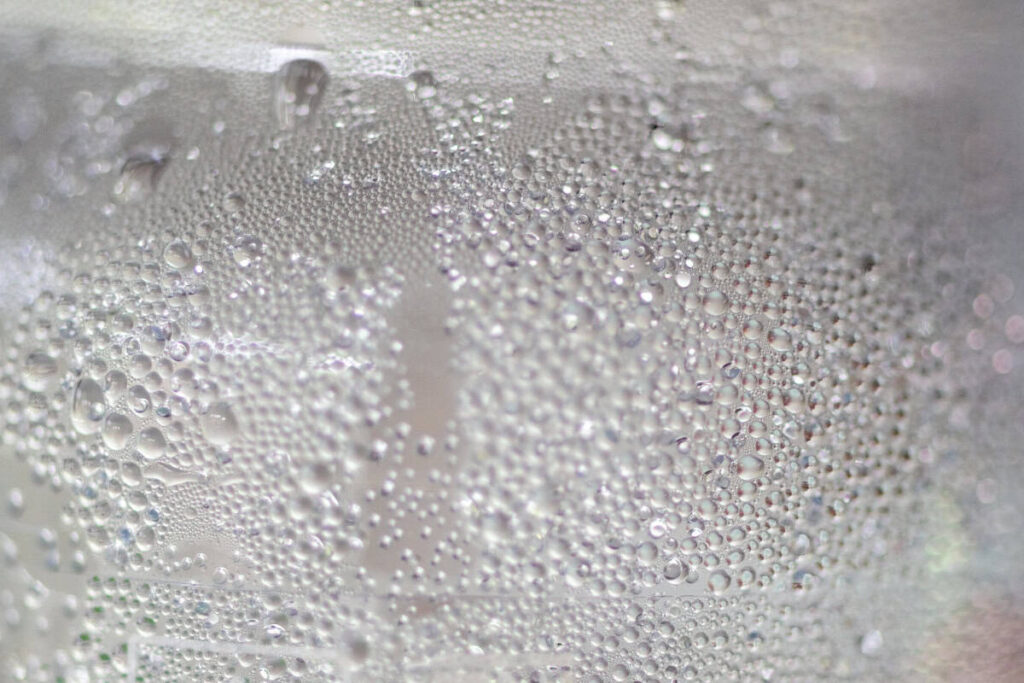
Engineering behind condensation in control cabinets
Dew point, temperature and relative humidity
The dew point is the temperature at which air becomes saturated with water vapor. When air cools below that point, condensation forms. The higher the relative humidity, the smaller the temperature difference needs to be before condensation occurs.
In a control cabinet, this can happen in several ways. A cabinet heats up during the day due to solar load, ambient temperature or component loss heat. At night, the enclosure cools, while moist air remains in the enclosure. Once surfaces in the cabinet become colder than the dew point, condensation can occur.
Alternating loads also play a role. An installation running during the day keeps the cabinet temperature higher due to internal heat generation. When the plant is turned off, that heat source falls away. The cabinet cools down, but the moist air present remains trapped. This is a typical situation where condensation can occur.
Therefore, for outdoor cabinets, control panels, traffic systems and industrial control cabinets, it is important to consider not only maximum temperature, but also minimum temperature, humidity and shutdown conditions.
Outdoor installation, IP class and enclosed cabinets
A higher IP rating protects against the ingress of dust and water, but does not automatically make a control cabinet condensation-free. In fact, a properly sealed cabinet can actually retain moisture once it enters.
Moisture can enter a cabinet in a number of ways. Humid air can be trapped during assembly or maintenance. Cable glands, penetrations or seals may not have been installed correctly. Pressure differences due to temperature changes can also cause air to be drawn in through small openings.
With outdoor enclosures, this plays extra strongly. Rain, frost, sun exposure and daily temperature variations cause varying pressure and temperature inside the enclosure. A stainless steel control cabinet or waterproof enclosure can be mechanically well protected, but still form condensation on the inside.
Therefore, IP54, IP55, IP65 or IP67 should not only be considered in terms of waterproofing. Pressure compensation, sealing, cable glands, anti-condensation plugs and cabinet placement also play a role. The right solution depends on the environment, the cabinet construction and the sensitivity of the electrical equipment.
Cabinet heater, hygrostat and thermostat
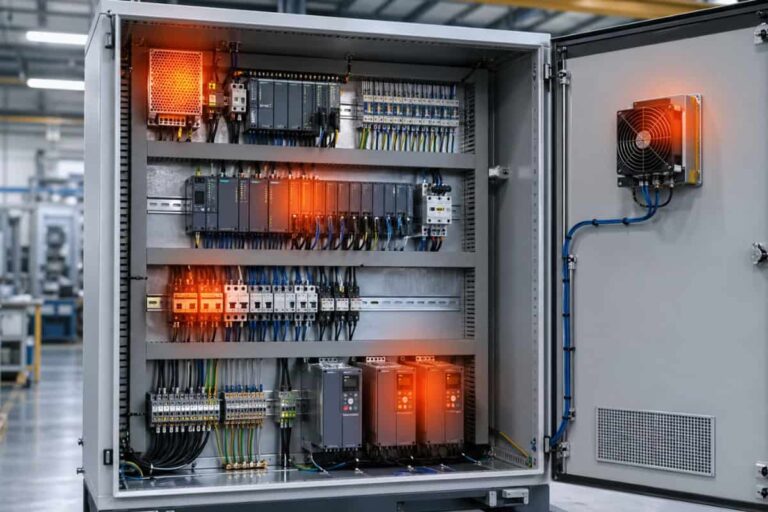
Cabinet heating is a commonly used measure to prevent condensation in control cabinets. The purpose is not to make the cabinet “warm,” but to prevent surfaces in the cabinet from falling below the dew point.
A heating element or cabinet heater keeps the temperature inside the cabinet just high enough to reduce condensation. This is especially relevant in outdoor setups, cold rooms, installations with shutdown periods or cabinets in which there is little inherent heat generation.
Control is important in this regard. A thermostat switches based on temperature. A hygrostat switches based on relative humidity. In many situations, a combination makes sense because condensation is determined not only by temperature, but also by humidity.
Industrial control cabinets include PTC control cabinet heaters, compact semiconductor heaters and fan heaters. A fan heater can be useful when heat needs to be distributed more evenly throughout the cabinet. For compact cabinets, a small heating element may be sufficient, provided the placement is correct and components do not get too hot locally.
It is important to match cabinet heating to the cabinet contents, IP class, ambient temperature and operating pattern of the installation. A heater that runs continuously unnecessarily uses energy and can stress components unnecessarily. A heater that is too small or improperly placed does not adequately prevent condensation.
Ventilation, cooling and condensation removal
Ventilation can help against condensation, but only if the outside air is suitable. If the outside air is drier than the air inside the cabinet, ventilation can remove moisture. But in humid, dusty or aggressive environments, ventilation can actually bring in additional moisture or contaminants.
Therefore, ventilation should always be evaluated in relation to the environment. A filter fan may work well in a clean technical room, but is less suitable when the cabinet is exposed to moist air, cleaning, splashing water or dust. With higher IP requirements, ventilation can also affect sealing.
Active cooling also requires attention. A cooling unit or air conditioner can lower the cabinet temperature, but temperature differences can create condensation risk if humidity, dew point and condensate drainage are not properly accounted for. For cooling units, therefore, control, internal air circulation and drainage of any condensation must be considered.
A heat exchanger can be an alternative when cabinet air and outside air must remain separate. This keeps the internal environment better protected from dust and moisture, while still allowing heat to be dissipated. Which solution fits depends on heat load, moisture load, IP class and the desired operating temperature.
You can read more about the choice between ventilation and active cooling on the air conditioning vs ventilation switchboard page. For situations where active cooling is required, a cooling unit panel may be an appropriate solution.
Why just a waterproof cabinet is not enough
A common assumption is that a waterproof control cabinet is automatically protected against condensation. In practice, this is not true. Waterproofing limits the ingress of water from outside, but it does not prevent moist air from condensing inside the cabinet.
A closed cabinet can actually be more susceptible to condensation once moisture is present. The cabinet keeps water from outside, but it also keeps moist air inside. With temperature changes, that moist air can precipitate on cold surfaces.
In addition, the complete design is decisive. An enclosure with a high IP rating can still cause problems due to incorrectly selected or mounted cable glands, feedthroughs, seals or condensate drain. Mounting position, orientation and maintenance also play a role.
Condensation prevention must therefore be part of the enclosure design. This means that the enclosure, component layout, IP rating, heating, ventilation, cooling and sealing are evaluated together. Only then is a solution created that works reliably in practice.
How Kwadrant IA helps prevent condensation
At Kwadrant IA, we look at condensation not as a separate moisture problem, but as part of the total heat and climate control of the control cabinet. Condensation touches on panel construction, component selection, cabinet layout, IP rating, ventilation, cooling and maintainability.
For new control cabinets, we include condensation prevention directly in hardware engineering and panel construction. For existing cabinets, we can assess why condensation occurs and what technical measures are needed.
Kwadrant IA can support:
- Assessing temperature, humidity and dew point;
- choice of cabinet heater, thermostat or hygrostat;
- determining the appropriate ventilation or cooling solution;
- Assess IP class, seals, glands and penetrations;
- Prevention of pressure differences and moisture trapping;
- integration of heating elements, fans or cooling units;
- improving maintainability and inspection;
- Protect PLCs, circuit boards, electrical connections and control panels.
Are you experiencing condensation in a control cabinet or want to prevent moisture problems in a new installation? Kwadrant IA assesses the cabinet structure, environment and climate control and translates this into a reliable solution.
Discuss your switchgear with a specialist.
Start your project with a technical consultation
We like to think with you from the initial design phase to realization and commissioning.
Related articles
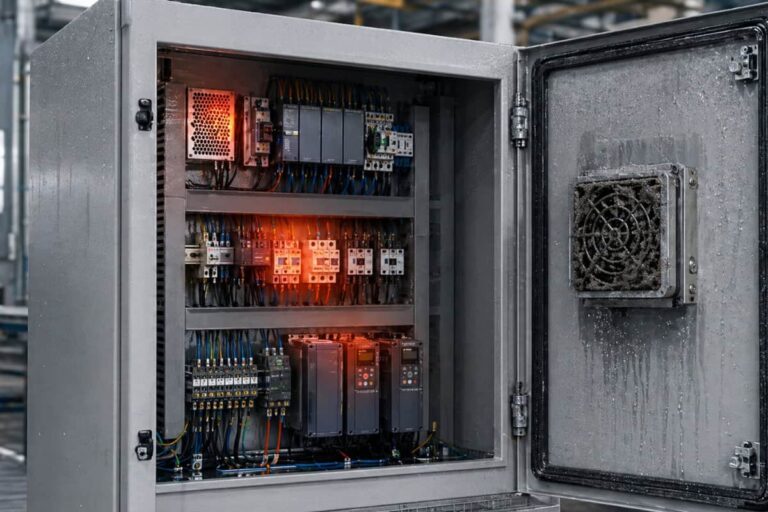
IP65 ventilation problem in control cabinets
An IP65 control cabinet is chosen to protect components from dust and water. This is important in industrial environments, production
When do you need cooling in a control cabinet?
A control cabinet always develops heat. That happens from components such as power supplies, PLCs, variable speed drives, relays, contactors,
5 causes of overheating in electrical cabinets
A control cabinet that gets too hot has usually been giving signals for some time. An inverter occasionally fails. A
Frequently asked questions about Preventing condensation in control cabinet
How does condensation form in a control cabinet?
Condensation occurs when moist air in the cabinet cools below the dew point. This occurs especially with temperature differences, high humidity, outdoor setups or installations that are not in continuous operation.
Is an IP65 or IP67 cabinet automatically condensation-proof?
No. A high IP rating limits the ingress of water and dust, but does not automatically prevent condensation from temperature differences or trapped moisture inside the cabinet.
When is cabinet heating necessary?
Cabinet heating is needed when the cabinet temperature can drop too far or when condensation must be prevented. This is often controlled with a thermostat, hygrostat or a combination of both.
Does ventilation help against condensation?
Ventilation can help when the outside air is drier and suitable. In damp, dusty or polluted environments, ventilation can actually bring in additional moisture or dust.
Can refrigeration cause condensation?
Yes. When active cooling cools the cabinet or components too much, condensation can occur. Therefore, cooling, humidity, dew point and condensation drainage should be evaluated together.
