
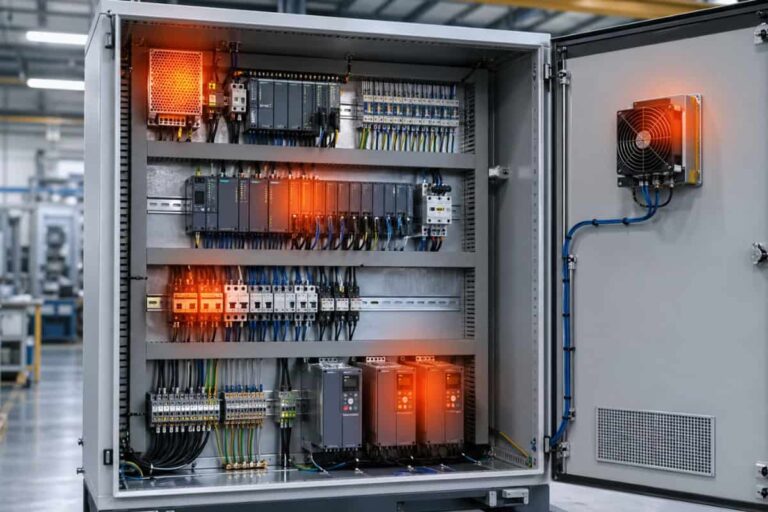
Switch cabinet with integrated air conditioner or cooling unit
Cooling unit panel
A cooling unit panel is an industrial control cabinet where active cooling is integrated directly into the cabinet design. The air conditioner or cooling unit keeps PLCs, variable speed drives, power supplies and other electronic components within the proper temperature range.
OPEN CALCULATION
Transparent cost structure and control of your project.
OFFER IN 5 DAYS
Quick technical assessment and clear planning.
DURABLE CONSTRUCTION
Lower Total Cost of Ownership.
UL/CSA IN-HOUSE
Directly compliant for international markets.
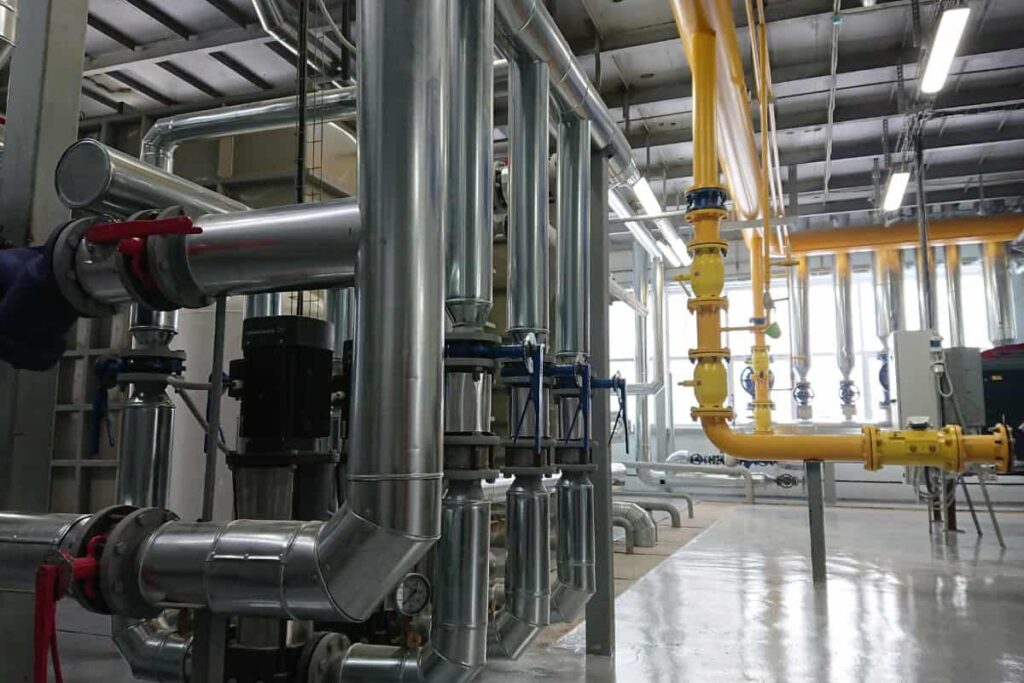
When and why a cooling unit panel is applied
A cooling unit panel is used when passive heat removal or ventilation is insufficient to control the temperature in the control cabinet. This is especially the case with high heat loads, compact cabinet construction, high ambient temperatures or installations where the cabinet must remain closed.
Unlike a fan, a cooling unit uses an active cooling process. Internal cabinet air is cooled and recirculated, while heat is dissipated on the outside of the cabinet. This keeps the cabinet better protected from dust, moisture and contaminated air from the environment.
Kwadrant IA applies cooling units as part of hardware engineering and panel construction. We look not only at the cooling unit itself, but at the complete control cabinet: component layout, air circulation, IP rating, condensate drainage, mounting position, maintainability and reliability of the installation.
Complete automation solutions
We realize control systems from design to delivery. By integrating engineering, panel construction, cabling and commissioning, we ensure quality, efficiency and international deployment.
What technical requirements determine implementation?
A cooling unit panel is not designed based on cabinet size alone. The proper design depends on the heat load, the environment and how the air conditioner is integrated into the cabinet.
Important technical requirements are:
- The heat load and required cooling capacity;
- The desired cabinet temperature and maximum ambient temperature;
- the IP class, dust load, moisture load and air pollution;
- The mounting method: wall-mounted, roof-mounted or integrated recessed;
- air circulation, condensate drain, maintenance room and monitoring.
Together, these factors determine which type of cooling unit is suitable, where it will be mounted and how the cabinet should be constructed internally. Determining the required cooling capacity requires an engineering calculation. You can read more about this on the page switch cabinet cooling calculation.
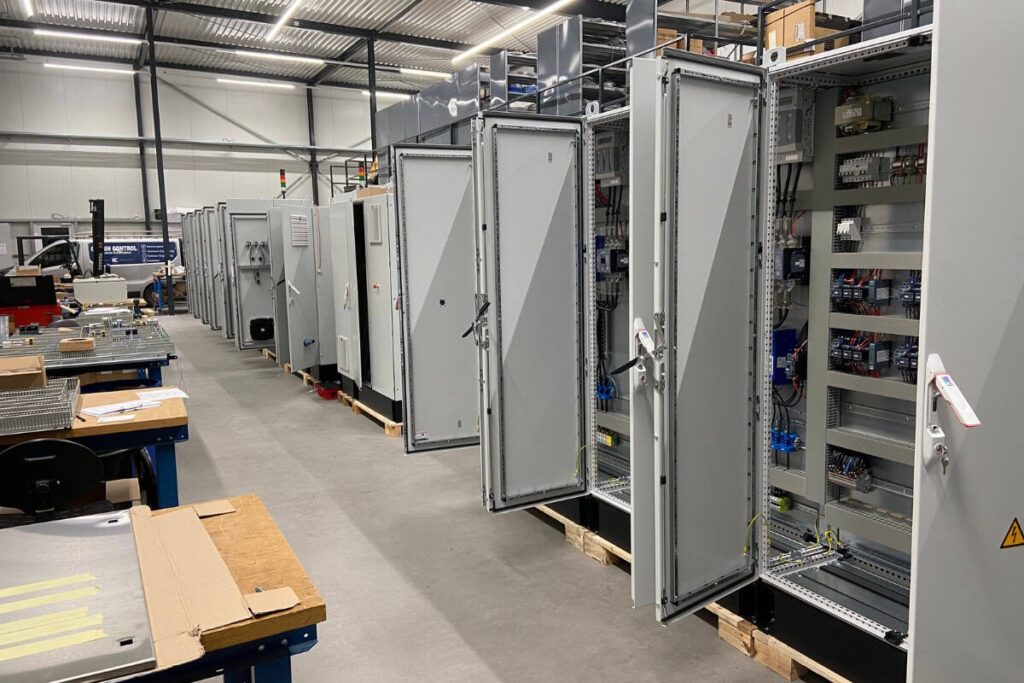
Operation of an air conditioner on a control cabinet
Closed refrigeration circuit with compressor, evaporator and condenser
A switchboard air conditioner operates with a closed refrigeration circuit. Basically, it consists of a compressor, refrigerant, evaporator, condenser and expansion valve. The evaporator extracts heat from the internal cabinet air. The condenser dissipates that heat to the environment outside the cabinet.
The important difference with ventilation is that internal cabinet air is not directly exchanged with ambient air. The air inside the control cabinet is cooled and recirculated. This better keeps dust, moisture, oily air and other contaminants out of the cabinet.
This makes a cooling unit especially suitable for industrial environments where standard ventilation poses too much risk. Think of production areas with dust, moisture, cleaning, high temperature or polluted air. Even with sensitive electronics, PLCs, HMIs, communication modules and variable speed drives, stable temperature control can be important for service life and operational reliability.
Internal air circulation and heat dissipation
A cooling unit is only effective if the air circulation in the cabinet is correct. The cooled air must reach the heat-producing components and the hot air must be properly drawn in by the unit. If cold air flows directly back into the unit, or if cable ducts and components block the airflow, hotspots will still occur.
Therefore, when designing a cooling unit panel, we consider the position of components, cable trays, mounting plates and air ducts. Frequent heat sources such as drives, power supplies and power components should not be placed in an area where heat lingers. Sensitive components such as PLCs, I/O modules and communications equipment should instead be protected from local temperature spikes.
The outside of the cabinet is also important. The cooling unit must be able to release its heat to the environment. This requires sufficient free space around air inlet and air outlet. If the unit is placed too close to a wall, machine frame or other cabinet, heat dissipation may be limited and cooling performance will drop.
Condensate drainage, humidity and dew point
Active cooling affects humidity and condensation. When air in the cabinet is cooled, the dew point can be reached. Then moisture from the air can condense on cold surfaces or in the cooling unit.
Therefore, a cooling unit panel should always consider condensate drain, humidity and control. Some units use a condensate evaporator; others require a drain line or controlled condensate drain. In outdoor or humid environments, additional control with temperature or humidity monitoring may be required.
Condensation is especially critical at electrical connections, circuit boards, connectors and terminal strips. Thus, an incorrectly set or poorly integrated cooling unit can cause new problems. Therefore, cooling and moisture control must be evaluated together. You can read more about this on the page preventing condensation in switchgear.
Mounting a cooling unit on or in the control cabinet
Wall mounted, roof mounted or recessed
Cooling units can be mounted in a variety of ways. The proper mounting form depends on the cabinet layout, available space, heat load and maintenance requirements.
With wall mounting, the cooling unit is placed on the side or door of the control cabinet. This is a common solution when there is sufficient space next to the cabinet and internal airflow can be properly arranged.
With roof mounting, the unit is placed on top of the cabinet. This can be advantageous when sides must remain clear or when the cabinet is in a row. However, consideration must be given to hot air, condensate drainage, accessibility and free space above the cabinet.
With flush mount or integrated surface mount, the cooling unit becomes part of the cabinet design. This requires more attention to mechanical cutouts, sealing, service accessibility and air routing, but can provide a neat and compact solution.
Air inlet, air outlet and clearance
The performance of a cooling unit depends greatly on its air intake and air outlet. Air must be able to flow freely both on the inside and outside. A unit with sufficient cooling capacity can still perform poorly if airflow is obstructed.
The cabinet design must therefore take into account:
- clear space around the cooling unit;
- Air conduction past heat-producing components;
- Preventing short circuits between cold supply air and warm return air;
- accessibility of filters, service panels and condensate drain;
- placement relative to cable trays, mounting plates and components.
These are practical panel construction details that directly affect reliability. So a cooling unit panel requires more than just selecting a cooling unit.
IP class, sealing and industrial environment
A cooling unit must match the desired IP rating of the control cabinet. Once a cutout is made for mounting, airflow or condensate drainage, the seal of the complete cabinet must be maintained.
In industrial environments, dust, moisture, splash water, cleaning and air pollution also play a role. In outdoor or aggressive environments, material selection can also be important, e.g. stainless steel housing or a version with higher corrosion resistance.
In international applications, NEMA or UL requirements may also be relevant. The correct implementation depends on the application, location and normative requirements for the installation. Kwadrant IA assesses this in conjunction with panel construction, component selection and environment.
Regulation, monitoring and maintenance
A cooling unit panel functions best when temperature control and monitoring are properly set up. Simple units operate with a mechanical thermostat. More sophisticated versions use electronic control, digital displays, temperature sensors and alarm contacts.
In industrial automation, monitoring can be valuable. Think of notifications in case of too high cabinet temperature, cooling unit failure, filter contamination or abnormal sensor values. Depending on the application, connection to a controller, HMI or building management system may be desirable, for example, via an alarm contact, RS485 or Modbus.
Maintenance remains important. Filters can foul, condensate drains can get clogged, and the outside of the unit must be able to continue releasing heat. Therefore, the cooling unit must be accessible for inspection and service. So a technically sound solution already takes into account maintenance space and accessibility after installation during engineering.
When is a cooling unit better than ventilation?
A cooling unit is better than ventilation when the cabinet temperature must be actively lowered or when outside air is not suitable for direct air exchange. Ventilation moves air but cannot lower the cabinet temperature below the ambient temperature.
A cooling unit is especially suitable when:
- the ambient temperature is higher than the desired cabinet temperature;
- the heat load in the control cabinet is high;
- dust, moisture or contaminated air must remain outside the cabinet;
- the cabinet must remain closed due to IP class or environmental requirements;
- sensitive electronics needs stable temperature control;
- machine or line downtime has major consequences.
In some situations, ventilation is sufficient. In other situations, a heat exchanger or active cooling makes more sense. We compare these options in more detail on the Air Conditioning vs Ventilation Switchboard page.
Design and panel construction of a cooling unit panel
A cooling unit panel is not a standard control cabinet with “an air conditioner on top.” The cooling unit must be included in the cabinet design from the design stage. Only then will cooling capacity, air circulation, component layout and maintenance fit together properly.
Design considerations include the placement of PLCs, AC drives, power supplies, HMIs, communication modules, protection devices and terminal blocks. Heat-producing components should be placed so that heat is properly dissipated. Sensitive components should be kept precisely out of hot spots.
Electrical integration also counts. The cooling unit needs proper connection, protection, control and possibly fault indication. In EPLAN and hardware engineering, this must be neatly incorporated so that the documentation, wiring and panel construction match the implementation.
For existing cabinets, a retrofit is possible, but not always easy. The cabinet must provide sufficient space, the heat load must be known, the IP rating must be maintained, and the mechanical mounting must be safe and maintainable. Therefore, an engineering assessment beforehand is necessary.
How Kwadrant IA helps with cooling unit panels
At Kwadrant IA, we design and build cooling unit panels as part of industrial panel construction and automation. We look not only at the cooling unit, but at the overall cabinet design and the application in which the cabinet functions.
We assess heat load, ambient temperature, IP class, component layout, air circulation, condensate drainage and maintainability. Based on this, we determine whether a cooling unit is the right solution and how it should be integrated technically.
Kwadrant IA can support:
- Determining the required cooling capacity;
- selection of an appropriate air conditioner or cooling unit;
- mechanical integration in or on the control cabinet;
- retain IP class and seal;
- designs of internal air circulation;
- Prevention of hot spots and condensation problems;
- electrical connection, protection and fault indication;
- EPLAN documentation, panel construction and commissioning.
Do you have a control cabinet where ventilation is inadequate or are you looking for a cooling unit panel for a new installation? Kwadrant IA assesses the heat load, cabinet layout and environment and integrates the right cooling solution into the panel design.
Discuss your switchgear with a specialist.
Start your project with a technical consultation
We like to think with you from the initial design phase to realization and commissioning.
Related articles
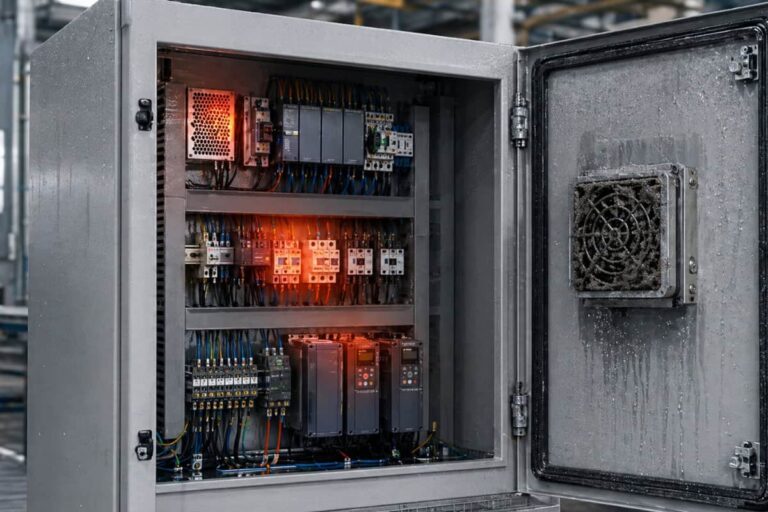
IP65 ventilation problem in control cabinets
An IP65 control cabinet is chosen to protect components from dust and water. This is important in industrial environments, production
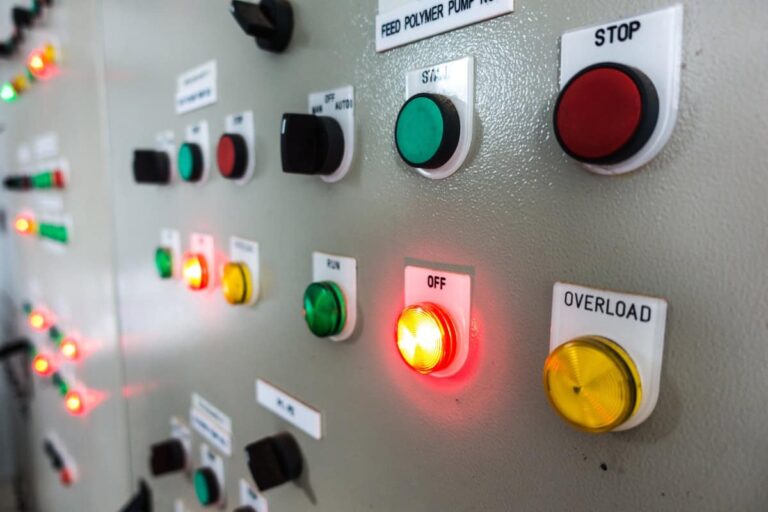
When do you need cooling in a control cabinet?
A control cabinet always develops heat. That happens from components such as power supplies, PLCs, variable speed drives, relays, contactors,
5 causes of overheating in electrical cabinets
A control cabinet that gets too hot has usually been giving signals for some time. An inverter occasionally fails. A
Frequently asked questions about Cooling unit panel
What is a cooling unit panel?
A cooling unit panel is a control cabinet or control box that incorporates active cooling with an air conditioner or cooling unit. The cooling unit keeps electronic components within the desired temperature range.
When is a cooling unit needed?
A cooling unit is needed when ventilation is insufficient. This plays out in high ambient temperatures, high heat loads, closed cabinets, high IP requirements or dirty and humid environments.
What is the difference between a cooling unit and a fan?
A fan moves air with the environment. A cooling unit actively cools with a closed cooling process and can lower the cabinet temperature even when the outside air is too hot.
What should you pay attention to when installing a cooling unit?
Important are cooling capacity, mounting position, air circulation, condensate drainage, IP class, electrical connection, service space and accessibility of filters or service points.
Can a cooling unit be applied to existing control cabinets?
Yes, but the cabinet structure, available space, heat load, IP rating and mechanical mounting must first be technically assessed. For existing cabinets, a retrofit is not always possible without modification.
