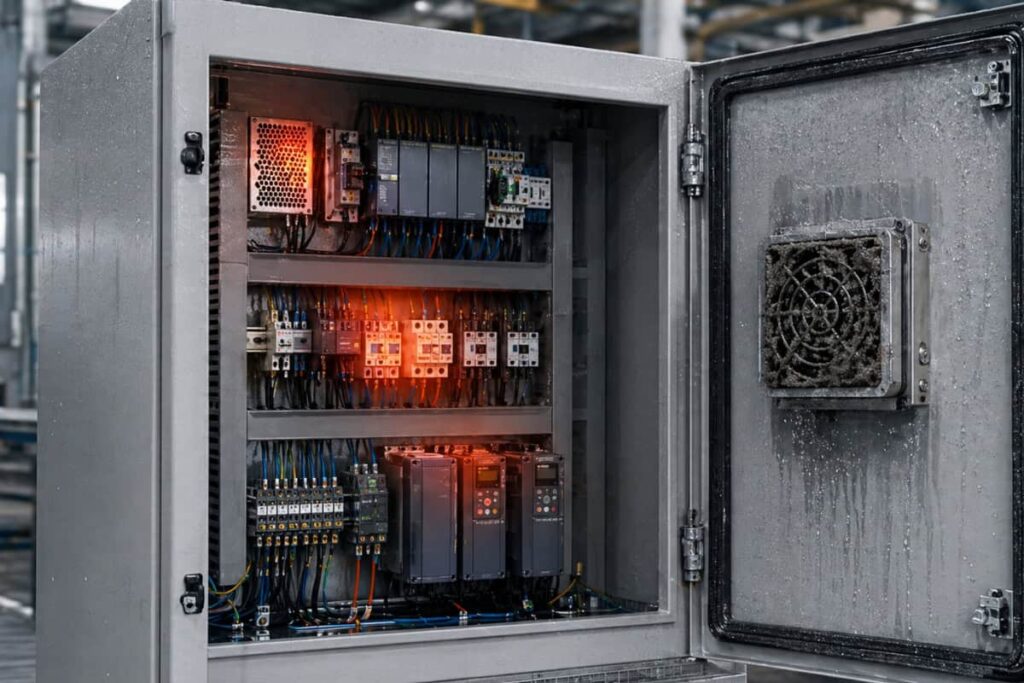
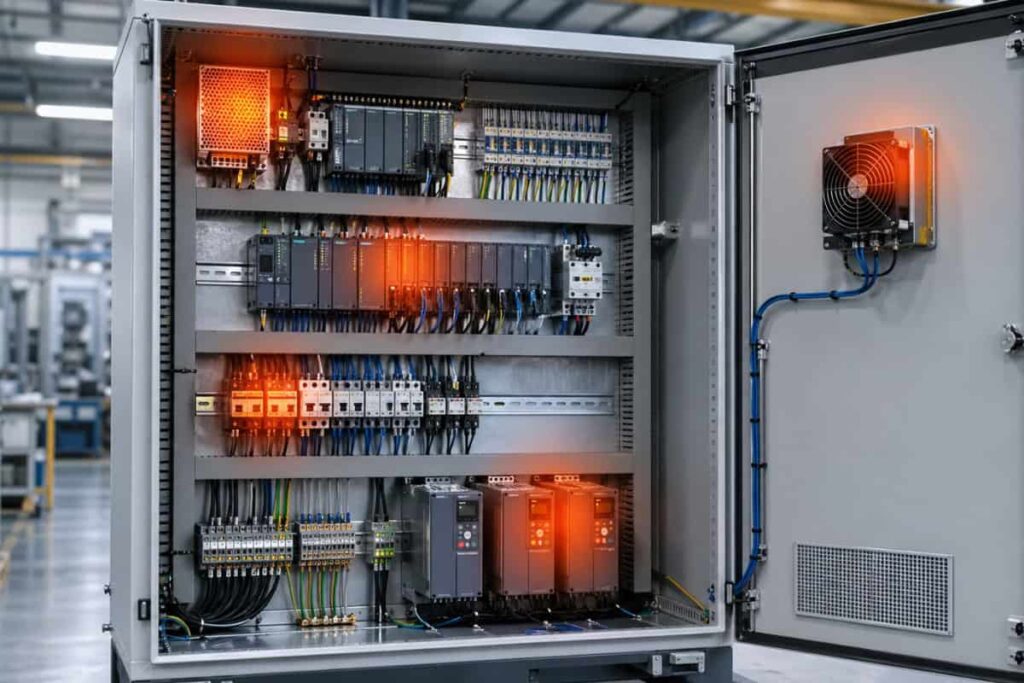
A control cabinet that gets too hot has usually been giving signals for some time. An inverter occasionally fails. A power supply gets hotter than expected. A fan runs continuously. Or a machine gives trouble especially on hot days or during peak loads.
Overheating rarely occurs from a single cause. It is often a combination of loss heat, limited air circulation, contamination, ambient temperature and moisture. In industrial plants, this can directly affect the reliability of machines, production lines and automation systems.
In this article, we discuss five common causes of overheating in switchboards and how a good approach to switchboard cooling helps prevent it.
Why overheating in a control cabinet is serious
A control cabinet is built to allow electrical components to operate safely and reliably. Consider PLCs, power supplies, relays, protections, variable speed drives, industrial computers, terminal blocks and cabling. These components produce heat, but are themselves sensitive to excessive temperature.
When cabinet temperatures become structurally too high, reliability decreases. Sometimes you see this directly in failures. In other cases, the problem arises gradually: components age faster, connections become more sensitive to contamination or a power supply gets less and less reserve.
Therefore, overheating is not a loose temperature problem. It is often a sign that the heat management of the cabinet no longer matches the load, environment or cabinet design.
1. Too much heat generated by components
The most obvious cause is the heat produced by components themselves. Every electrical system has loss heat. Some of the energy in components is converted into heat.
This is normal, but it becomes a problem when more heat is generated than the cabinet can dissipate. Especially in compact automation cabinets, we often see this. More components get into the same enclosure, while space for air circulation is limited.
Typical heat sources include:
- variable speed drives and motor controllers;
- power supplies and transformers;
- softstarters and power modules;
- industrial computers and networking equipment;
- inverters and other power electronics.
Therefore, when designing a switchgear cabinet, not only electrical function, connection voltage and protection must be considered. The dissipated power also counts. A cabinet can be constructed completely correctly electrically but still be designed too tightly thermally.
Want to know how much heat dissipation a cabinet needs? Then it makes sense to calculate the control cabinet cooling based on component load, cabinet area and ambient temperature.
2. Poor air circulation due to closet layout.
Sometimes the biggest problem is not the amount of heat, but the way that heat travels through the cabinet.
Warm air rises. If airflows in the cabinet are blocked by cable trays, full mounting plates or improperly placed components, heat lingers locally. This can create hotspots around power supplies, drives or sensitive electronics.
This happens mostly with cabinets that were later expanded. Additional equipment is added, but the original cabinet structure remains the same. Electrically it still fits, but thermally it no longer does.
A good closet layout takes into account:
- sufficient clearance around heat-producing components;
- logical separation between warm and cooler zones;
- free airflow past power supplies, drives and power components;
- accessibility for inspection and maintenance.
This is exactly where panel construction and engineering come together. A control cabinet must not only be neatly wired, but also constructed in such a way that heat can be dissipated in a controlled manner.
3. Contaminated or malfunctioning ventilation.
Ventilation can be a great solution, but only as long as airflow remains reliable. In practice, this is not a given. Filters get dirty, fans wear out and air intakes are sometimes blocked by dust, dirt or cabinet placement.
A filter fan that had sufficient capacity when it was delivered may not move enough air over time. The temperature then slowly rises, without anything having been directly changed in the installation. This is precisely why this cause is often discovered late.
In clean technical rooms, ventilation is often well applicable. In factory halls or production areas with polluted air, the situation is different. Dust and dirt can plug filters and, in some cases, also enter the cabinet. This creates not only a cooling problem, but also additional risk of contamination of electrical components.
With ventilation, pay particular attention to three points:
- Is the outside air cooler than the desired cabinet temperature?
- Does the air stay clean enough for the components in the cabinet?
- Are filters and fans easily accessible for maintenance?
If the answer to any of these questions is no, ventilation may not be the best solution. On the Air Conditioning vs Ventilation Switchboard page, we explain when ventilation is sufficient and when active cooling makes more sense.
4. High ambient temperature or harsh operating conditions.
A control cabinet never functions independently of its environment. The temperature in the production room, technical room or outdoor setup determines how much heat the cabinet can still dissipate.
Ventilation works only when the air outside the cabinet is cooler than the desired temperature inside the cabinet. If the environment is already too warm, a fan moves mostly warm air. The cabinet is then ventilated, but not sufficiently cooled.
You can see this for example at:
- factory halls with lots of process heat;
- technical rooms with limited ventilation;
- cabinets close to machines, furnaces or drives;
- outdoor cabinets with direct sunlight;
- plants running continuously or at high loads.
A cabinet that functions well in the spring can still cause problems in the summer. This is why in industrial applications we design not only for average conditions, but also for peak load and maximum ambient temperature.
When the ambient temperature is higher than the desired cabinet temperature, active cooling is often necessary. In that case, a cooling unit panel can be an appropriate solution.
5. Moisture, condensation and contamination in the cabinet
Moisture may seem like a different problem than overheating, but in switchboards, temperature, humidity and pollution are strongly interrelated.
With fluctuations in temperature, condensation can form. Consider outdoor cabinets, cold nights, hot days or installations that are not in continuous operation. Condensation can cause corrosion of electrical connections, leakage currents and malfunctions.
Dust compounds the problem. A layer of dust on components traps heat. If that contamination becomes damp, it can also create electrical risk. Therefore, when dealing with damp or contaminated environments, it is important to look not only at cooling, but also at sealing, IP rating and moisture control.
With enclosed cabinets, an additional consideration arises. A high IP rating protects against dust and water, but often limits natural heat dissipation. Open ventilation can dissipate heat, but at the same time can bring in dust or moisture. So the right choice requires balance.
You can read more about this topic on the page Preventing Condensation in Switchgear Cabinet.
How do you prevent overheating?
You don’t prevent overheating by installing a larger fan or cooling unit by default. Sometimes active cooling is necessary, but often the solution starts earlier: with engineering, component selection and cabinet construction.
A good approach starts with a few technical questions:
- How much loss heat do the components produce?
- what is the maximum ambient temperature?
- Is the cabinet free-standing, against a wall or built-in?
- Is the outside air clean enough for ventilation?
- Should the cabinet maintain a certain IP rating?
- Is maintenance on filters or fans practical?
Based on this, it can be determined whether passive heat dissipation is sufficient, or whether ventilation, a heat exchanger or active cooling is required. Equally important is that the cabinet is constructed so that airflows are not blocked and heat-producing components are in the right place.
For a broader overview of solutions and concerns, continue reading on the main page on switchgear cooling.
How Kwadrant IA helps with overheating in switchboards
At Kwadrant IA, we look at the control cabinet as part of the complete automation process. Overheating is rarely just a cooling problem. Often cabinet layout, component load, air circulation, IP rating, ambient temperature and maintenance all play a role at the same time.
For new panels, we include thermal management directly in hardware engineering and panel construction. With existing cabinets, we can assess why temperatures are rising and what solution makes technical sense. Sometimes a different cabinet layout is sufficient. Sometimes ventilation is appropriate. And in other situations active cooling is needed.
Are you dealing with a hot control cabinet, failures at high loads or doubts about the right cooling solution? Kwadrant IA assesses the cabinet structure, heat generation and environmental conditions and helps think about a reliable solution.
Discuss your switchgear with a specialist.