
Choose the right cooling solution for your control cabinet
Air conditioning vs ventilation control cabinet
Ventilation moves air, while air conditioning actively cools. Which solution fits depends on heat load, ambient temperature, IP rating, dust, moisture and the operational reliability your system demands.
OPEN CALCULATION
Transparent cost structure and control of your project.
OFFER IN 5 DAYS
Quick technical assessment and clear planning.
DURABLE CONSTRUCTION
Lower Total Cost of Ownership.
UL/CSA IN-HOUSE
Directly compliant for international markets.
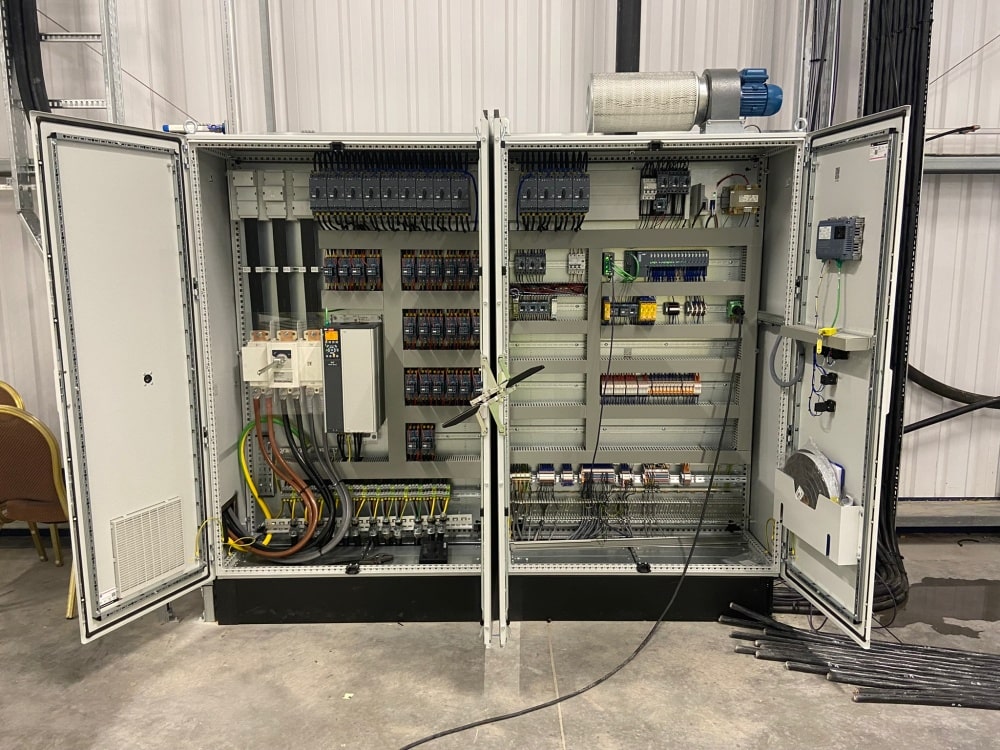
Why the choice between air conditioning and ventilation is important
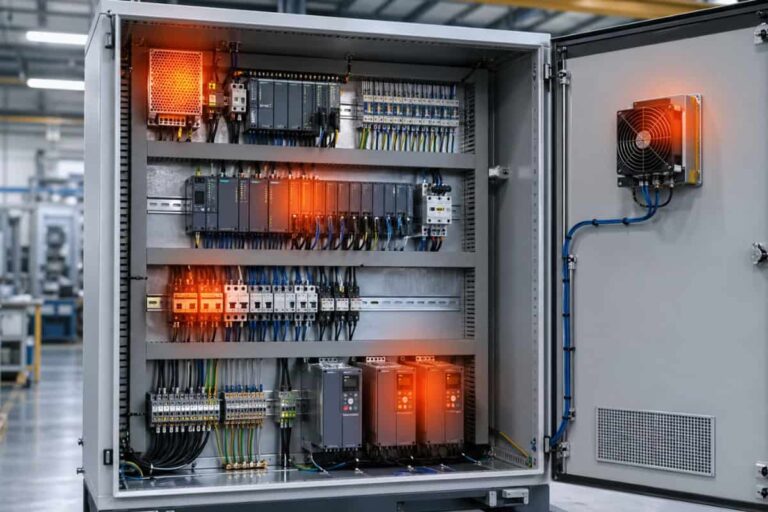
In a control cabinet, heat is generated by electrical and electronic components. Consider PLCs, power supplies, variable speed drives, relays, softstarters, industrial computers and network components. As long as that heat is properly dissipated, the cabinet temperature remains manageable. If heat dissipation becomes insufficient, then malfunctions, wear and tear and failure risk increase.
Ventilation and air conditioning do not solve the same problem. A fan exhausts warm air and brings cooler outside air into the closet. This only works when that outside air is suitable. Air conditioning or a cooling unit actively dissipates heat and can lower the cabinet temperature even when ventilation is not enough.
Kwadrant IA evaluates this choice as part of hardware engineering and panel construction. In doing so, we look not only at the temperature in the cabinet, but also at component loads, cabinet construction, IP rating, air circulation, maintainability and the environment in which the system must operate.
Complete automation solutions
We realize control systems from design to delivery. By integrating engineering, panel construction, cabling and commissioning, we ensure quality, efficiency and international deployment.
What factors determine the right choice?
The choice between ventilation, heat exchanger or air conditioning starts with the thermal housekeeping of the complete cabinet. The focus is not on the cooling solution, but on how much heat must be dissipated and under what conditions.
Important factors are:
- heat load and required cooling capacity;
- maximum ambient temperature and desired indoor temperature;
- dust, moisture, air pollution and IP class;
- maintainability of filters, fans or cooling units;
- energy consumption, operational reliability and risk of downtime.
In practice, the choice is rarely black and white. Sometimes ventilation is sufficient, sometimes a heat exchanger makes more sense, and sometimes active cooling is necessary. For a broader explanation of the options, read on to the main page on switchboard cooling.
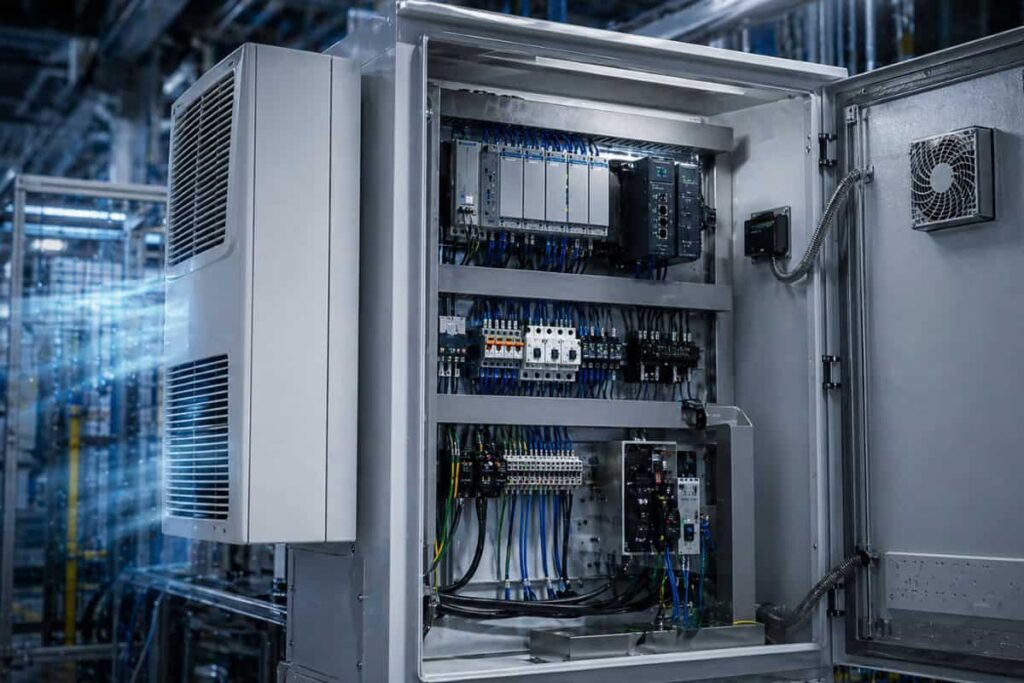
Technical difference between ventilation, heat exchanger and air conditioner
Ventilation and filter fans
Ventilation is the simplest form of active heat removal. A fan or filter fan moves air: warm air is exhausted and cooler outside air is introduced into the cabinet. This can be a good solution with limited heat loads and a clean, cool environment.
The advantage of ventilation is that the solution can be relatively simple, compact and energy efficient. A fan uses less energy than a cooling unit and usually requires less space in or on the cabinet.
But ventilation has definite limits. The outside air must be cooler than the desired cabinet temperature. If the ambient temperature is too high, mostly warm air is moved. The cabinet is then ventilated, but not adequately cooled.
In addition, ventilation requires maintenance. Filters and filter mats can become fouled by dust, fibers, oily air or other contaminants. Once the air flow rate decreases, so does heat dissipation. In production environments, therefore, accessibility of filters is not a detail, but part of the design.
Heat exchangers with separated air flows
A heat exchanger is of interest when open ventilation is not desirable, but heat must be dissipated. With an air-to-air heat exchanger, the cabinet air and outside air remain separate. Heat is transferred without contaminated outside air entering the cabinet directly.
This is especially useful in environments with dust, moisture or air pollution. A heat exchanger may also be a better fit than a regular fan in higher demands for protection of electronics.
An air-to-water heat exchanger goes one step further and uses cooling water to remove heat. This can be of interest in industrial environments where cooling water is available or where air cooling is not practical.
However, a heat exchanger is not an air conditioner. Its operation remains dependent on temperature differences and available exhaust options. When the ambient temperature is too high or the cabinet temperature must be actively lowered, a cooling unit is often necessary.
Air conditioner or cooling unit for active cooling
An air conditioner or refrigeration unit uses an active cooling process to remove heat from the switchgear cabinet. This is often done with a compressor, refrigerant and a closed refrigeration circuit. This allows the cabinet temperature to be kept lower than is possible with ventilation.
Active cooling is especially relevant when there are high heat loads, high ambient temperatures or closed cabinets. Also, when outside air is too dusty, humid or polluted, a cooling unit may be the better choice. The cabinet remains better protected and temperature control is more precise.
Air conditioning for control cabinets is not about comfort cooling, but process reliability. The cooling solution must protect electronic components, prevent malfunctions and keep the plant operating reliably.
Therefore, the cooling capacity must be properly matched to the heat load. A unit that is too small does not cool adequately. A unit that is too large uses energy unnecessarily and can contribute to condensation problems if improperly controlled. For applications requiring active cooling, a cooling unit panel can be an appropriate solution.
When do you choose ventilation?
Ventilation is appropriate when the heat load is limited and the outside air can be used to dissipate heat. This means that the ambient air must be cooler than the desired temperature in the cabinet as well as clean enough for the components.
In practice, ventilation is often applied to switchboards in clean engineering areas, sheltered machine environments or situations where IP requirements permit ventilation. Filter maintenance must also be readily achievable. In practice, a filter fan that is not accessible is often cleaned or replaced too late.
Ventilation fits especially when:
- the heat load is limited;
- the outside air is cooler than the desired cabinet temperature;
- the air is clean enough for air exchange;
- the IP class allows ventilation openings;
- filters and fans are easily accessible;
- an energy-efficient and simple solution is desired.
When in doubt, it is important to look not only at the average temperature, but also at peak load. A cabinet that functions well under normal conditions may still become too hot on hot days or under higher machine loads.
When do you choose air conditioning or a cooling unit?
Air conditioning or a cooling unit is needed when ventilation cannot adequately dissipate heat. This happens, for example, when the ambient temperature is higher than the desired cabinet temperature. A fan cannot then provide real cooling because the air supplied is already too hot.
Active cooling also makes sense when the cabinet must remain closed. Consider environments with dust, moisture, splashing water, air pollution or high IP requirements. Open ventilation can then affect the protection of the cabinet or bring contaminants inside.
Air conditioning or a cooling unit fits especially when:
- the ambient temperature is too high for ventilation;
- the heat load in the cabinet is high;
- the cabinet must remain closed;
- dust, moisture or contaminated air must remain outside the cabinet;
- sensitive electronics stable temperature control demands;
- machine or line downtime has major consequences.
A chiller unit requires more attention to energy consumption, installation and maintenance than a fan. On the other hand, temperature control is more manageable and the cabinet can remain better protected from environmental influences.
Costs, energy consumption and maintenance
Ventilation is often the simplest and most energy-efficient solution. A fan consumes relatively little power, is compact and can dissipate sufficient heat under the right conditions. The costs are mainly in the components, installation and periodic cleaning or replacement of filters.
Air conditioning and refrigeration units are more technically elaborate. They use more energy, occupy more space and require proper control and maintenance. Mounting position, air circulation around the unit, condensate drainage and accessibility for service must also be considered.
Yet ventilation is not automatically cheaper. If ventilation is inadequate, breakdowns, component failure and lost productivity can be much more costly than a correctly chosen cooling solution. Conversely, a cooling unit is not always necessary when a simple ventilation solution will reliably suffice.
Therefore, energy-efficient climate control starts with proper calculation. The required cooling capacity must fit the heat load, environment and operating conditions. On the Switchboard Cooling Calculation page, we explain how the required cooling capacity is determined.
How Kwadrant IA helps choose between air conditioning and ventilation
At Kwadrant IA, we make the choice between air conditioning, ventilation and heat exchanger not on the basis of a standard product, but on the basis of the complete control cabinet and the application in which it is used.
We assess heat load, component classification, IP class, ambient temperature, air circulation, maintainability and reliability requirements, among other things. We also consider the practical implementation: where will the fan or cooling unit be located, how will the air flows, will filters remain accessible and will the cabinet remain suitable for the environment?
For new control cabinets, we incorporate the cooling solution directly into hardware engineering, EPLAN design and panel construction. For existing cabinets, we can assess why ventilation is deficient or why active cooling becomes necessary.
Kwadrant IA can support:
- choice between ventilation, heat exchanger and active cooling;
- Calculation of heat load and cooling capacity;
- determining the proper placement of fans or cooling units;
- Assessing IP class, sealing and air pollution;
- Integration of cooling solutions into new or existing switchboards;
- improving maintainability and operational reliability.
Are you unsure between ventilation, heat exchanger or active cooling? Kwadrant IA assesses heat loads, cabinet layout and environmental conditions and recommends a solution that fits your installation.
Discuss your switchgear with a specialist.
Start your project with a technical consultation
We like to think with you from the initial design phase to realization and commissioning.
Related articles
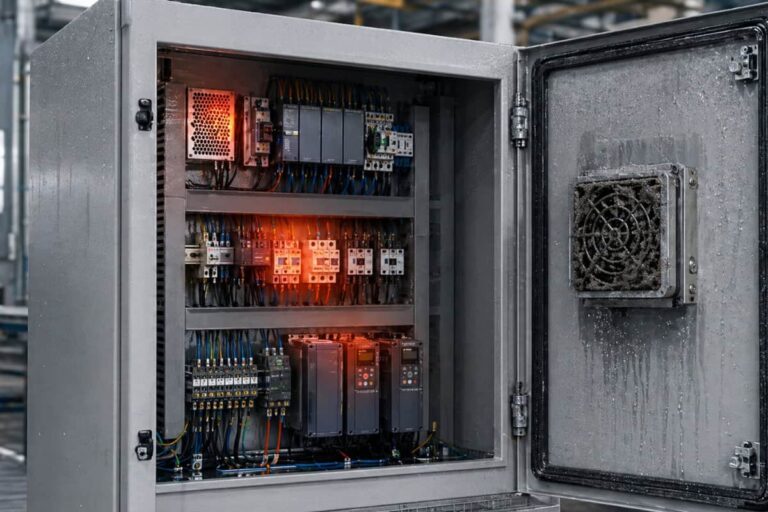
IP65 ventilation problem in control cabinets
An IP65 control cabinet is chosen to protect components from dust and water. This is important in industrial environments, production
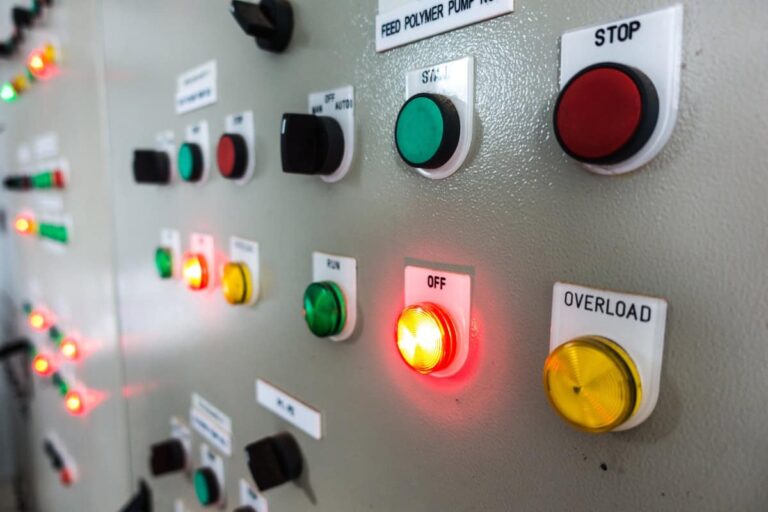
When do you need cooling in a control cabinet?
A control cabinet always develops heat. That happens from components such as power supplies, PLCs, variable speed drives, relays, contactors,
5 causes of overheating in electrical cabinets
A control cabinet that gets too hot has usually been giving signals for some time. An inverter occasionally fails. A
Frequently asked questions about Air conditioning vs ventilation control cabinet
Is ventilation sufficient for a control cabinet?
Ventilation is sufficient when the heat load is limited and the outside air is cooler and clean enough to dissipate heat. Also, the IP rating must allow ventilation and filters must be easily maintainable.
When is air conditioning needed in a control cabinet?
Air conditioning or a cooling unit is needed when ventilation is insufficient. This plays out in high ambient temperatures, high heat loads, closed cabinets, high IP requirements or dirty and humid environments.
What is the difference between a fan and a heat exchanger?
A fan brings outside air into the cabinet to remove heat. A heat exchanger dissipates heat while keeping cabinet air and outside air separate. This keeps the cabinet better protected from dust and moisture.
Is air conditioning more expensive than ventilation?
In purchase and energy consumption, it usually is. But for critical plants, active cooling can be cheaper than breakdowns, component failures or machine and line downtime due to excessive cabinet temperatures.
Can an IP65 control cabinet be ventilated?
This is only possible if the ventilation components and mounting fit the required IP rating. In many situations, closed cooling, a heat exchanger or cooling unit is better to maintain the seal.
