
SCADA Systems for Industrial Facilities
- Real-time process insight
- Industrial Reliability
- Scalable architecture
OPEN CALCULATION
Transparent cost structure and control of your project.
OFFER IN 5 DAYS
Quick technical assessment and clear planning.
DURABLE CONSTRUCTION
Lower Total Cost of Ownership.
UL/CSA IN-HOUSE
Directly compliant for international markets.
Real-time process insight via a SCADA system
A SCADA (Supervisory Control and Data Acquisition) system is the higher-level software layer that collects, visualizes, and records data from PLC controllers, enabling operators to monitor and adjust a process from a central location.
Kwadrant IA designs and implements SCADA systems for machines and facilities where operational continuity is critical. We tailor the architecture to your process and to the existing PLC controls, from functional design through commissioning.
Operators and technicians get a real-time overview of process values, alarms, and trends. You can use historical data for analysis, maintenance, and targeted optimization of the plant.

SCADA and PLC: Two Layers in a Single Control System
A SCADA system serves as the upper layer above the PLC control system. While the PLC directly controls the process and processes signals from sensors and actuators in real time, SCADA focuses on visualization, monitoring, and data collection.
Process values, alarms, and trends are consolidated into a single, centralized view. This gives operators insight into the current status of multiple installations at the same time and makes it easier to manage, compare, and optimize processes.
SCADA is used in environments where continuity and reliability are essential, ranging from a single production line to geographically dispersed facilities. If you’d like to start with the basics, read about what exactly a SCADA system is and how it compares to a PLC.
Standards and Guidelines for SCADA Systems
NEN-EN 60204-1
This standard applies to the electrical equipment of machines connected to PLCs and SCADA systems. It provides a framework for the safe design, safe installation, and testing of control systems.
NEN 1010
NEN 1010 outlines the safety requirements for low-voltage installations. This standard is also relevant for SCADA solutions, for example, regarding power supplies, cabling, and the connection of control and visualization components.
Functional Safety: PL and SIL
If the SCADA system provides information to safety functions, the PL or SIL methodology is used. For machinery, this is EN-ISO 13849-1 with Performance Level PLd or PLe, supplemented by EN/IEC 62061. For process plants, IEC 61511 applies to Safety Instrumented Systems. This involves a methodical approach to safety, not certification of the SCADA system itself. You can read more about this on our page about machine safety.
Benefits of a SCADA System
- Central overview of processes and systems
- Rapid detection and analysis of malfunctions
- Historical data for optimization and maintenance
- Better support for operators and technicians
These benefits contribute to greater operational reliability and more manageable processes.
Start your project with a technical consultation
We like to think with you from the initial design phase to realization and commissioning.
SCADA in Practice
A SCADA system is used in situations where process insight and centralized monitoring are critical:
- Machine Building and Production Lines
- Infrastructure and Water Management
- Internal Logistics and Automated Systems
- Energy and Process Facilities
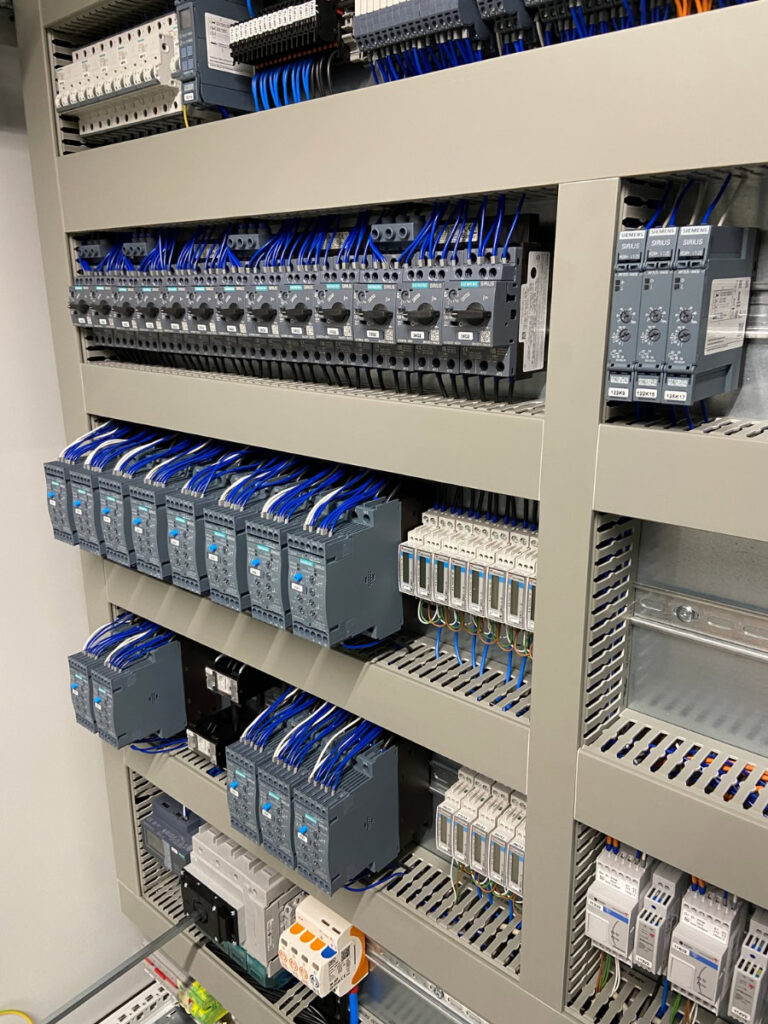
In these applications, SCADA supports monitoring, alarm management, and reporting. The associated hardware is housed in industrial control cabinets with an appropriate IP rating, such as IP54 or IP65, depending on the environment.
You can find a concrete example of this approach in our PLC control system for water treatment plants.
Technical Architecture of a SCADA System
A SCADA solution typically consists of servers, clients, and communication links to the underlying PLCs. Industrial communication protocols ensure reliable data exchange between these layers. User management, logging, and trend analysis are standard components of any serious system design.
The choice of protocol determines how the connection between the PLC and SCADA performs in terms of response time, diagnostics, and scalability. For a standardized and future-proof connection, we often use OPC UA between the PLC and SCADA . At the field level, we work with, among other things, Profinet and EtherCAT, and for IoT-focused monitoring, we use MQTT Sparkplug B. We make this choice deliberately, based on the specific installation rather than on a standard package.
The software engineering and documentation are carried out using EPLAN P8 with macro libraries, which ensures a structured and maintainable design that will still be understandable five years from now.
Years of experience in the field of industrial automation
From functional design to commissioning
The process begins with the functional design of the SCADA system, tailored to your process and the existing PLC controllers, such as a Siemens S7-1500. This is followed by configuration, integration, and testing.
FAT and SAT are standard steps used to verify the system’s operation and reliability before it goes into production. During the FAT, we check the configuration and functionality before the system is shipped to the site. After installation, the SAT is performed, during which the system’s operation is tested in a real-world environment.
After successful testing, we commission the SCADA system and hand it over to the user, including documentation and version control.

Kwadrant IA as a Partner for SCADA Systems
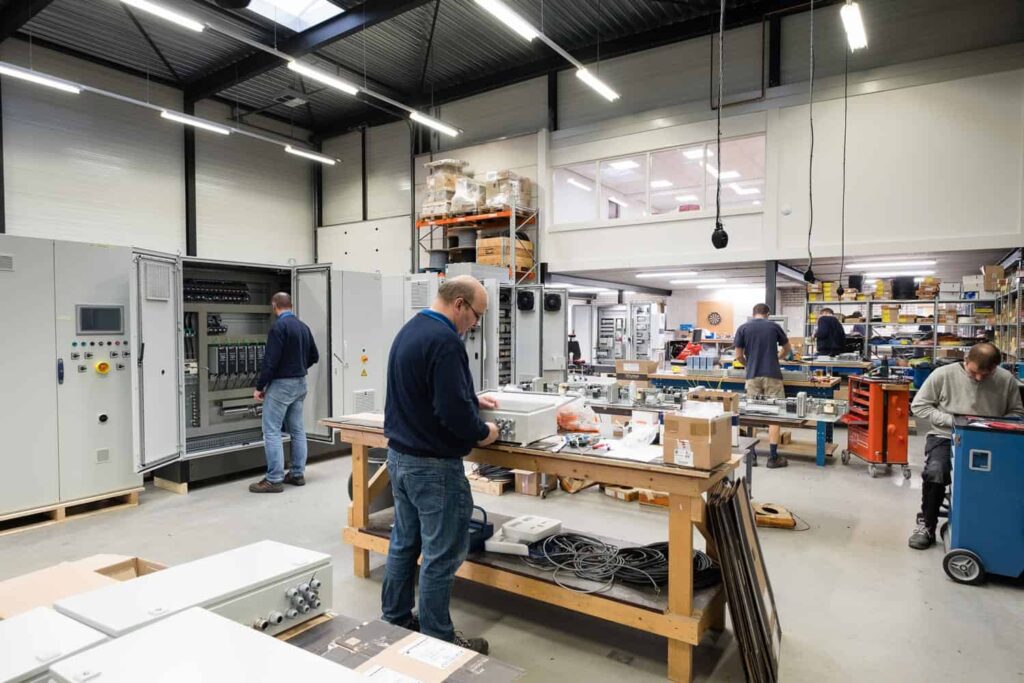
We support industrial organizations in the design and implementation of SCADA systems. By combining software engineering, panel building, and commissioning under one roof, we deliver solutions tailored to the realities of industrial environments, rather than relying on standard configurations.
We design and build control panels and SCADA hardware in accordance with NEN-EN 61439 and NEN-EN 60204-1. As a UL-Listed Panel Shop, we also manufacture panels in accordance with UL 508A for export to the U.S. and Canada.
Thanks to our experience in sectors such as mechanical engineering, infrastructure, water management, and logistics, we serve as a technical partner from design through to completion.
Would you like to know how SCADA can help you gain better insight into your processes? Contact us for advice or a technical assessment.
Frequently Asked Questions About SCADA Systems
What is the difference between a PLC and a SCADA system?
A PLC directly controls the process and processes signals from sensors and actuators in real time. A SCADA system is the higher-level layer that collects, visualizes, and stores data from PLCs. The PLC controls the process, while SCADA provides insight through visualization, alarm management, and reporting. Together, they form the core of an industrial control system. Read the detailed comparison between SCADA and PLC.
What does a SCADA system do in industry?
A SCADA system provides centralized insight into industrial processes. It displays process values, status information, and alarms, and enables trend analysis. This allows operators to respond more quickly to anomalies. In addition, the system supports data logging and reporting, which aids in the optimization and maintenance of facilities.
In which industries are SCADA systems used?
SCADA is used in mechanical engineering, infrastructure and water management, internal logistics, energy, and the process industry. Whenever multiple installations or processes need to be monitored, a SCADA system provides an overview and manageability. The solution is tailored to the specific environment and business processes.
Which standards apply to a SCADA system?
NEN-EN 60204-1 and NEN 1010 are relevant to the electrical safety of the connected systems. If SCADA plays a role in safety functions, we follow the PL or SIL methodology: EN-ISO 13849-1 and EN/IEC 62061 for machinery, and IEC 61511 for process installations. We apply these standards without making any unfounded certification claims regarding the SCADA system itself.
How is a SCADA system tested and commissioned?
Testing is conducted in two steps. During the FAT, the configuration and functionality are verified before the system is shipped to the site. After installation, the SAT is performed, during which the system’s operation is tested in a real-world environment. This ensures that the commissioning process proceeds in a controlled and predictable manner.
