
Machine Safety
- Safety in accordance with Machine Directive and applicable standards
- From risk assessment to safe control
- One partner for engineering, panel building and software
OPEN CALCULATION
Transparent cost structure and control of your project.
OFFER IN 5 DAYS
Quick technical assessment and clear planning.
DURABLE CONSTRUCTION
Lower Total Cost of Ownership.
UL/CSA IN-HOUSE
Directly compliant for international markets.
Machine safety secured across the entire control pathway
Machine safety is the set of measures by which a machine is designed, built and controlled so that risks to operators and the environment are reduced to an acceptable level. In Kwadrant IA, machine safety is not an isolated component, but a chain that runs from risk assessment, through the design of safe control functions, to validation at commissioning. By including safety as early as the design phase of the control system, emergency stop circuits, door monitoring and monitoring of moving parts are performed reliably and verifiably. The result is an installation that is safe to operate, detects faults early and operates predictably.
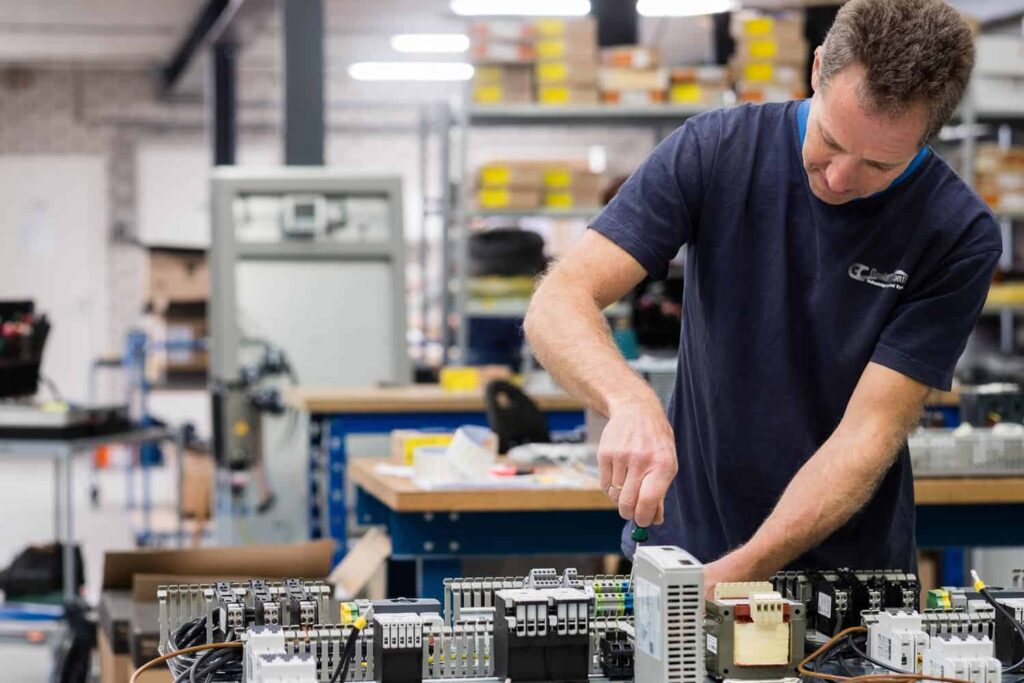
Machine safety in four interrelated parts
Machine safety consists of four components that build on each other: from identifying risks to the safe controls that manage them.
Safety relays & components
Emergency stop, door monitoring and light curtains, reliably switched and monitored.
Machinery Directive & CE Marking
From guideline and risk assessment to demonstrable compliance.
Safety PLC & Performance Level
Safe control according to EN-ISO 13849 and the required Performance Level.
Machine safety at every stage of the life cycle
Design phase
The design phase lays the foundation for machine safety. Here you conduct a risk assessment, determine the required safety functions and establish the required Performance Level for each function. Choices made here determine the reliability of the entire safety chain.
Use phase
During operation, the machine must be safe to operate and reliably detect faults. Safety functions such as emergency stop and door monitoring intervene when necessary, while the control system ensures predictable and repeatable operation.
Maintenance phase
Safety also remains the guiding principle during maintenance. A machine must be able to be stopped safely, for example via a lock-out/tag-out procedure (LOTOTO), and existing machines must be reassessed for safety when they are modified or redeployed. reassessed for safety..
Standards, guidelines and legislation around machine safety
Machinery Directive and Machinery Regulation
The Machinery Directive 2006/42/EC sets the requirements that a machine must meet before it is placed on the market in the EU. This directive is being replaced by the new Machinery Regulation (EU 2023/1230), which will be fully applicable from 2027. For manufacturers, this means tightened requirements around risk assessment, documentation and digital safety.
Work equipment directive and national legislation
Whereas the Machinery Directive focuses on the manufacturer, the Work Equipment Directive, the Machinery Commodities Act and the Occupational Health and Safety Decree place the responsibility on the employer to ensure that machinery is used safely. Both frameworks must be aligned.
EN-ISO 13849-1 and EN 62061 (functional safety)
EN-ISO 13849-1 describes how to determine the Performance Level (PL) of a safety function and realize it; EN 62061 does this through the Safety Integrity Level (SIL). Both standards define the required reliability and fault detection of the safety chain.
NEN-EN 60204-1 (electrical equipment of machines)
NEN-EN 60204-1 sets requirements for the electrical equipment of machinery, including emergency stop devices, cabling and testing. The standard provides the basis for the safe electrical construction of controls.
CE marking and notified body
CE marking shows that a machine complies with the applicable directives. The manufacturer is responsible for this; certain categories of machinery require involvement of a notified body. Notice: CE marking on the máchine is different from CE marking on the control cabinet.
Start your project with a technical consultation
We like to think with you from the initial design phase to realization and commissioning.
Machine safety in mechanical engineering and industry
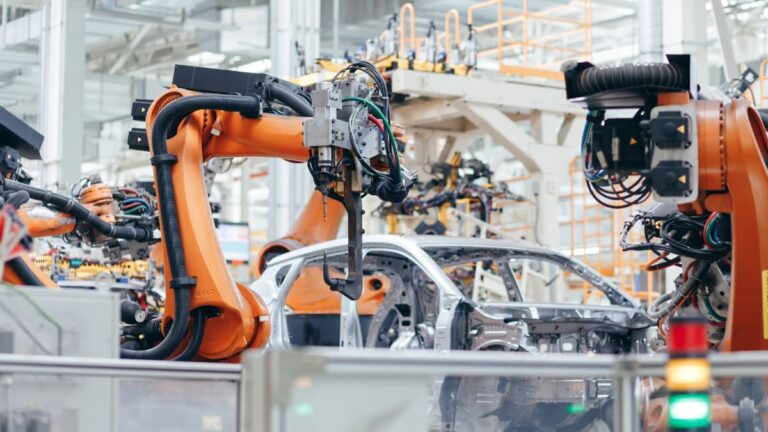
Machine safety comes into play wherever people and machines come together. Think of production lines with moving parts, robot cells and cobots, transport and dosing systems and automated production cells. Depending on the risk level, safety functions are more heavily implemented, and the safety chain is integrated with the existing PLC and HMI control. Kwadrant IA applies machine safety in sectors such as mechanical engineering, internal logistics, food and broader industrial automation.
Kwadrant IA as a partner for machine safety
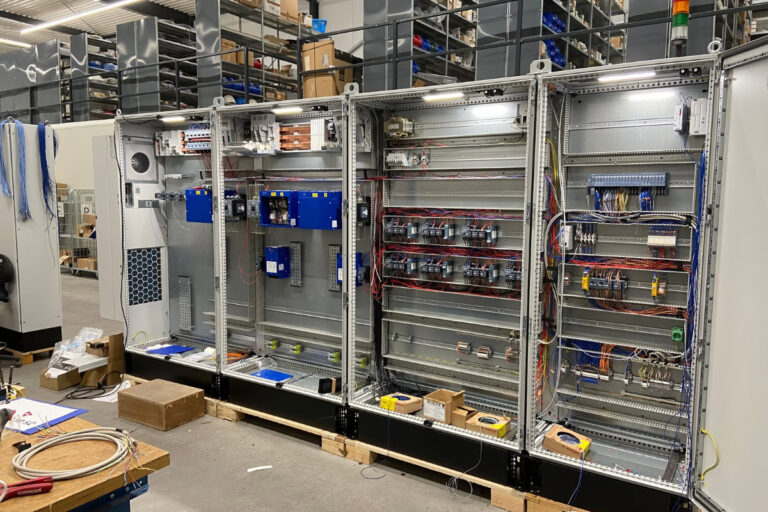
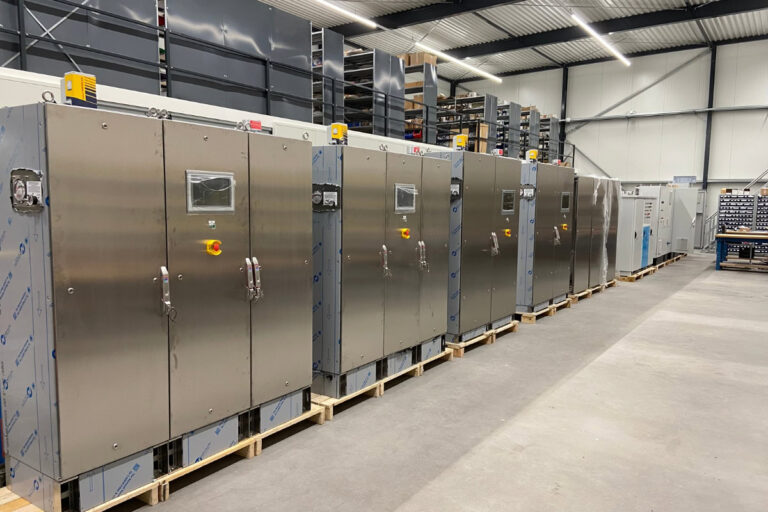
Kwadrant IA secures machine safety across the entire process: from risk assessment and engineering, through panel construction, to software and validation. Because we control engineering, panel construction and control software in-house, safety functions are consistently designed, built and tested – including through a Factory Acceptance Test and Site Acceptance Test. Our process is transparent with open calculation, a quote within five working days and UL/CSA certification in-house for those supplying internationally.
We do not build standard solutions, but technically sound systems that match the complexity of modern mechanical engineering.
Years of experience in the field of industrial automation
Industrial automation with international standards
Industrial automation requires more than just a correctly constructed panel. We start with the architecture of the system and make conscious choices in component selection, standardization and scalability. By fully mastering engineering, panel construction and integration, we realize control systems that perform reliably in demanding industrial environments. From modular construction to international compliance, every detail is focused on quality, longevity and manageable Total Cost of Ownership.
We do not build standard solutions, but technically sound systems that match the complexity of modern mechanical engineering.
Frequently asked questions about machine safety
What is covered by machine safety?
Machine safety includes all measures that prevent a machine from causing injury or damage. That starts with a risk assessment and includes safe control functions, emergency stop circuits, guards and the monitoring of moving parts, plus the documentation that proves the machine meets applicable standards.
Who is responsible for machine safety - the manufacturer or the employer?
Both, but for different stages. The manufacturer must place a new machine on the market safely according to the Machinery Directive and is responsible for CE marking. The employer must then have the machine safely used and maintained in accordance with the Work Equipment Directive and the Occupational Health and Safety Decree.
What is the difference between the Machinery Directive and the new Machinery Regulation?
The Machinery Directive 2006/42/EC is the current framework; the Machinery Regulation (EU) 2023/1230 replaces it and is fully applicable from 2027. Among other things, the regulation tightens requirements around risk assessment, digital documentation and cybersecurity.
When is a risk assessment or RI&E required?
A risk assessment is mandatory for any new machine under the Machinery Directive and for any major modification of an existing machine. For the workplace as a whole, the RI&E obligation under the Occupational Health and Safety Act also applies.
Does machine safety also apply to existing machinery?
Yes. Existing machinery must remain safe during operation and maintenance, and when a major change is made, the requirements for a new machine often apply. A renewed risk assessment determines what safety measures are needed.
