Table of Contents
The History of Software Engineering
OPEN CALCULATION
OFFER IN 5 DAYS
SUSTAINABLE INNOVATIONS
UL/CSA
IN HOUSE
The Role of Software Engineers
Tools and Technologies in Software Engineering
Software Development Environments (IDEs)
Contact our experienced innovator
Cees Brasser
With more than 26 years of experience at the helm of Kwadrant IA, Cees Brasser is your expert on panel construction for the mechanical engineering sector. Discover how his knowledge and insight can take your project to new heights. Get in touch now!
Version Control (Git, SVN)
Version control (Git, SVN) is a critical component for ensuring software development. It is a process that ensures the files and documents used to build software remain secure and up to date. Fixing bugs and optimizing the software makes it easier for different people within an organization to collaborate on a project.
Version control typically uses Git or SVN. Git uses a distributed version control model that makes it easy to compare different versions of a file. SVN uses centrally managed version control that streamlines the organization of different parts of a file. Both offer a reliable way to track different versions of a file, so you don’t have to worry about lost changes.
Monitoring and Logging
Monitoring and logging are two crucial approaches that companies use to improve performance and security. Through monitoring, companies can keep an eye on their network and applications. This allows them to proactively identify and resolve issues. Logging helps improve their understanding of their systems and strengthen their network security.
Monitoring and logging enable organizations to track their IT environment, leading to improved performance and security. Monitoring and logging provide organizations with insight into their infrastructure and applications, enabling them to quickly and successfully identify and resolve issues. These two components give organizations knowledge about their IT environment that can help prevent or explain problems.
Test Automation
Test automation is a strategy that more and more companies are adopting. It involves replacing manual testing of complex software with automated testing. This reduces the amount of time and effort spent on manually testing software. This technique also collects important information. Test automation allows companies to evaluate their software across various scenarios. To carry this out properly, at least one year of experience is required.
Test automation is a fantastic tool that helps organizations improve the quality of their reliable software. It also offers an opportunity to increase efficiency, resulting in savings in both time and money.
Your electrical engineering ambitions, our mission
Our expert team at Kwadrant IA is ready to turn your electrical issues into concrete solutions. Are you ready for the next step?
Continuous Integration and Delivery (CI/CD)
Continuous Integration and Delivery (CI/CD) is a key component of modern software engineering. It enables programmers to improve the quality of their code. In addition, it reduces costs and shortens the time required to deploy database applications. Through CI/CD, developers can continuously compare their code with other components to detect and fix errors before they go into production. This ultimately leads to superior software that is more secure and easier to manage.
See our vacancies
And join the nicest electrical engineering team in the Netherlands. Want to know more? Then get in touch with us.
Security
Security may well be the most important aspect of any business. Companies must strive to effectively protect their networks, data, and systems against cyberattacks. Security consists of two elements: preventive measures to avoid problems and detection measures to determine whether an attack has already occurred. To implement security effectively, a practical solution must be put in place.
A company’s security can be improved in various ways. This can be done, for example, by using antivirus software or firewalls. An online learning environment can certainly contribute to this. In addition, companies must implement appropriate security practices to prevent unauthorized access to their data and systems. This can be achieved by creating complex passwords and restricting access to certain systems. By implementing appropriate security measures, organizations can protect their data and systems from online threats.
The Difference Between Software and Hardware Engineering
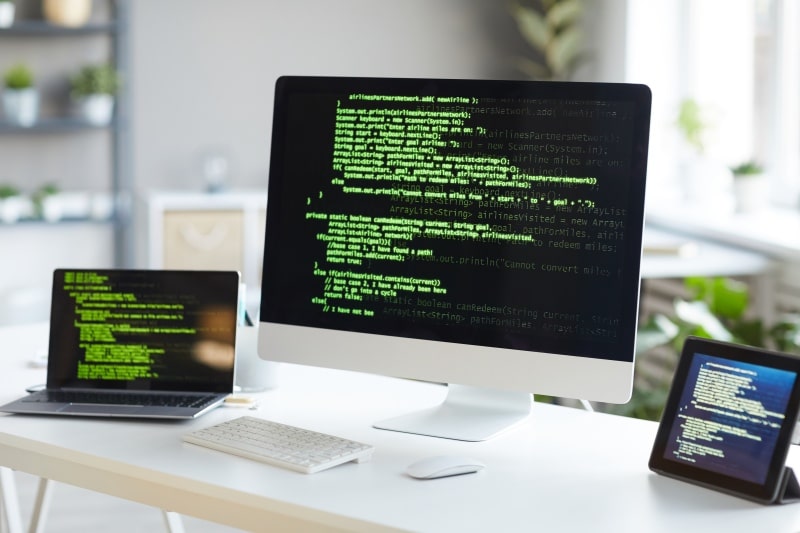
Software engineering involves the design, construction, and maintenance of technical models and software systems. Hardware engineering, on the other hand, focuses on the design, manufacture, and development of systems composed of physical components. Software engineers write code to create programs, while hardware engineers design control cabinets, chipsets, network components, and drives.
In industrial automation, these two disciplines work side by side. A control system only functions properly when the electrical design and the software are coordinated. That is why we perform hardware engineering and software engineering under one roof.
Different Types of Roles in Software Engineering
There are many different types of software engineers—from developers and testers to project managers and executives. Some focus on code and technology, while others focus on project management and leading a team. Quality testing, security, and data analysis are distinct fields within this field.
In industrial automation, the focus is different from that in traditional IT. A PLC programmer develops control software that operates a machine or system, with safety and reliability as the top priorities. If you’re interested in a career in this field, check out our current job openings.
Why is software engineering important?
Software engineering focuses on the quality, reliability, and safety of embedded software and control programs. By following these principles, applications become more efficient, more reliable, and easier to use.
Good software engineering also increases the efficiency of the development process, allowing a project to proceed more quickly and predictably without compromising quality.
It also plays a key role in security. Security risks are identified and mitigated during and after construction, which provides better long-term protection against cyberattacks. For industrial control systems, this is not just theory; see IEC 62443 for industrial cybersecurity.
In short, software engineering is essential for efficient, reliable, and secure software that meets the actual needs of a system.

Related Articles

Modbus, Profinet or Profibus? Industrial communication protocols compared
Modbus, Profinet and Profibus are three widely used industrial communication protocols, each with its own role. Modbus is a simple, vendor-neutral protocol for sensors, meters

What is a SCADA system and how does it compare to a PLC?
A Supervisory Control and Data Acquisition (SCADA) system is software that allows operators to centrally monitor and control industrial processes. It collects real-time data from

IP65 ventilation problem in control cabinets
An IP65 control cabinet is chosen to protect components from dust and water. This is important in industrial environments, production areas, outdoor setups or installations

When do you need cooling in a control cabinet?
A control cabinet always develops heat. That happens from components such as power supplies, PLCs, variable speed drives, relays, contactors, network components and cabling. In

5 causes of overheating in electrical cabinets
A control cabinet that gets too hot has usually been giving signals for some time. An inverter occasionally fails. A power supply gets hotter than

ATEX zone 1 vs. zone 2: what does it mean for your control cabinet?
Within industrial environments where explosion hazards are present, ATEX zones are often used. Yet in practice we see that the difference between zone 1 and