
Protection against dust, moisture and contamination in industrial environments
Overpressure control cabinet: design and operation
An overpressure switchgear cabinet prevents external influences from entering and provides a stable internal environment in which electrical components continue to function reliably.
OPEN CALCULATION
Transparent cost structure and control of your project.
OFFER IN 5 DAYS
Quick technical assessment and clear planning.
DURABLE CONSTRUCTION
Lower Total Cost of Ownership.
UL/CSA IN-HOUSE
Directly compliant for international markets.
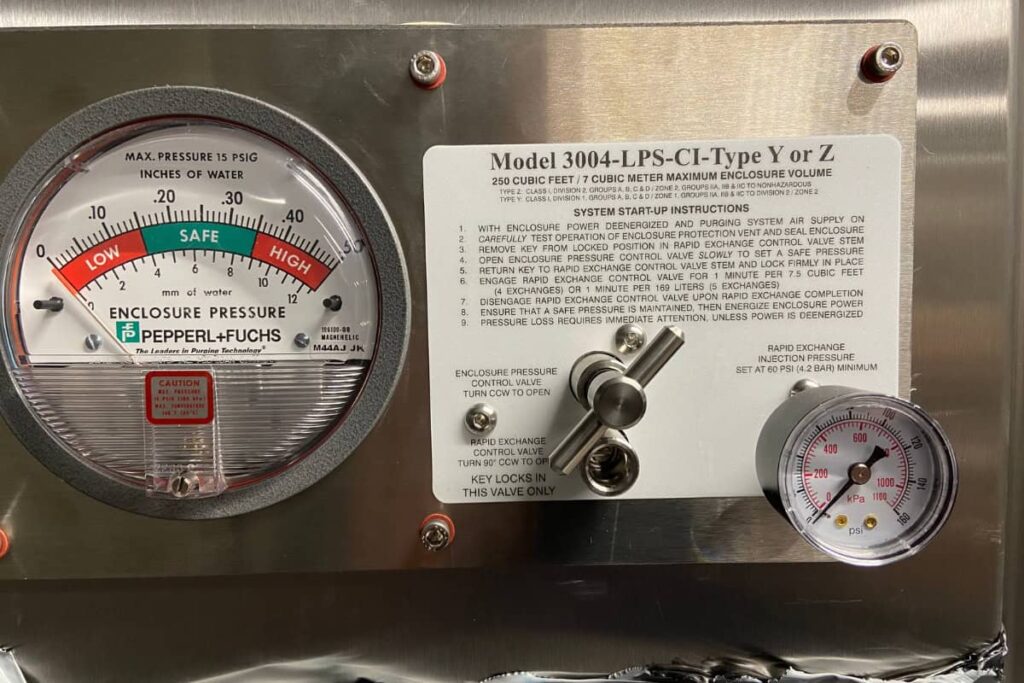
Overpressure control cabinets in industrial applications
A positive pressure switchgear cabinet is designed to keep contaminated or moist ambient air out through controlled airflow and slight overpressure.
Instead of passively circulating air through the cabinet, filtered air is actively blown in. This creates an overpressure that prevents dust, moisture or corrosive vapors from being drawn in through gaps or penetrations.
These systems are used in such applications as:
- production environments with dust or fibers
- installations in damp or corrosive environments
- outdoor setups with varying weather conditions
Kwadrant IA designs positive pressure switchgear cabinets as an integral part of the installation. Not only the cabinet, but also air flows, filtration and thermal behavior are included.
Complete automation solutions
We realize control systems from design to delivery. By integrating engineering, panel construction, cabling and commissioning, we ensure quality, efficiency and international deployment.
Operation and application of overpressure in control cabinets
An overpressure system ensures that the internal pressure of the control cabinet is higher than the environment. This prevents contaminated air from entering uncontrolled.
The effectiveness of this solution depends entirely on its proper application, cabinet design and the conditions under which it is used.
When is an overpressure system needed?
An overpressure system is used in environments where contamination or moisture has a direct impact on the reliability of electrical components.
These plays include:
- dusty production environments
- installations with moist or corrosive air
- outdoor setups with temperature changes
In these situations, standard ventilation is insufficient. Air is then drawn in uncontrollably, including dust and moisture.
An overpressure system prevents this by controlled air supply and filtration. It is important to mention that overpressure is not a solution for explosive environments. In those cases, a purge system is required.
How does a positive pressure switch box work?
A positive pressure switch cabinet operates with a controlled airflow where filtered air is actively introduced into the cabinet.
Operation consists of:
- suction of ambient air
- filtration of dust and contaminants
- controlled supply in the cabinet
- creating a slight overpressure
This positive pressure prevents unfiltered air from being drawn in through seams, doors or cable penetrations.
Unlike purge systems, there is no purge phase and no ATEX protection. The system is aimed at protecting against contamination and moisture, not explosion hazards.
Key design choices
The operation of a positive pressure switchgear cabinet is determined by its design. Small errors at this stage lead directly to reduced effectiveness.
Important design choices include enclosure sealing, positioning of air inlet and outlet, and routing of airflows through the enclosure.
In addition, filtering plays a crucial role. The choice of filter type and frequency of maintenance greatly determine how well the cabinet remains protected.
A good design ensures even air distribution and prevents dead zones where heat or contaminants can accumulate.
Common mistakes and risks
In practice, we see that positive pressure systems are frequently misapplied or inadequately developed.
Common errors are:
- install fans without controlled airflow
- lack of filtering
- insufficient sealing of the cabinet
- no allowance for condensation
As a result, contaminated air still enters or moisture accumulates in the cabinet.
A positive pressure system only works if the overall concept is right. Adding individual components without engineering rarely leads to a reliable solution.
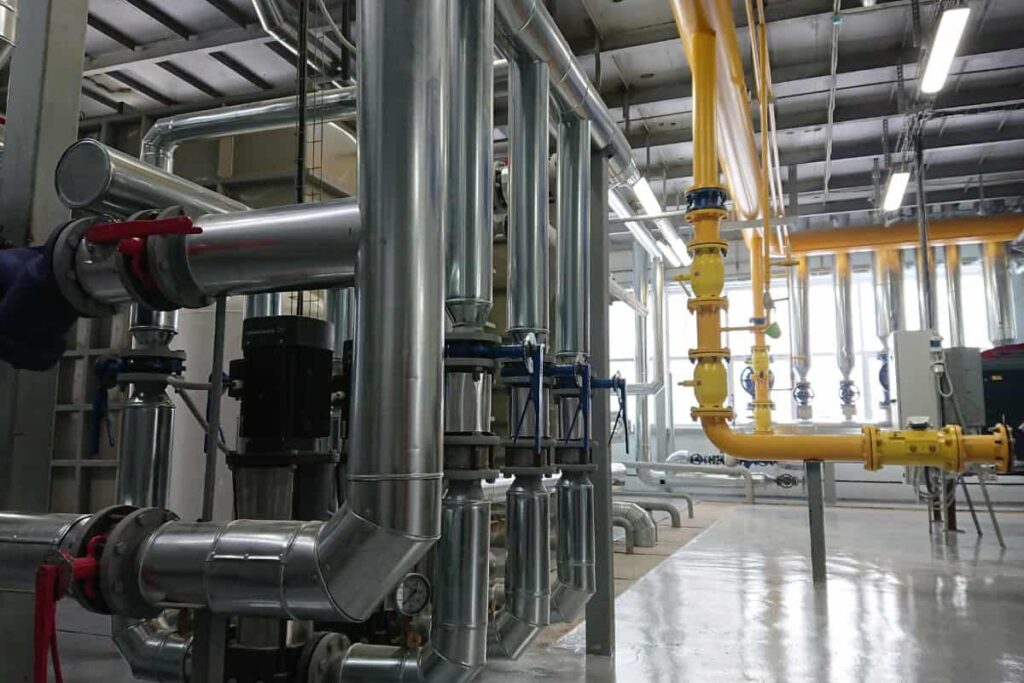
Technical floor of overpressure control cabinets
Air flows and ventilation in switchgear cabinets
The effectiveness of a positive-pressure system is largely determined by airflow within the cabinet.
Air must move in a controlled manner from inlet to outlet, past the components to be cooled or protected. Improper positioning of fans can lead to short-circuit currents or dead zones.
In practice, this means:
- air intake and exhaust should be strategically positioned
- components cannot be randomly placed
- heat-producing components require extra attention
Poorly designed airflow makes an overpressure system ineffective, regardless of the components used.
Filtration and pollution protection
Filtering is essential to prevent dust and contaminants from entering the cabinet.
Depending on the environment, different filter types are chosen, ranging from coarse to fine dust filters. The choice depends on the nature and concentration of pollution.
An important consideration is maintenance. Filters become saturated and lose function, which directly affects airflow and overpressure.
A clogged filter means less air supply and thus loss of positive pressure.
Condensation and temperature differences
Condensation is a common problem in switchgear cabinets, especially in environments with temperature changes.
When warm, moist air comes into contact with colder surfaces in the cabinet, condensation forms. This can lead to corrosion, short circuits and component failure.
An overpressure system helps mitigate this, but only if:
- the airflows are correctly designed
- temperature differences are controlled
- moist air does not enter uncontrolled
In practice, condensation is often underestimated, even though it is one of the main causes of failures.
Overpressure vs. cooling
Overpressure and cooling are often mixed up, but have different functions.
Overpressure is meant to keep out contamination and moisture. Cooling is meant to dissipate heat.
In situations with high thermal loads, overpressure alone is not sufficient and active cooling must be applied, for example with fans or air conditioning.
The right choice depends on:
- the power of the components
- the ambient temperature
- the desired operational security
A wrong choice leads to overheating or insufficient protection.
Monitoring and reliability
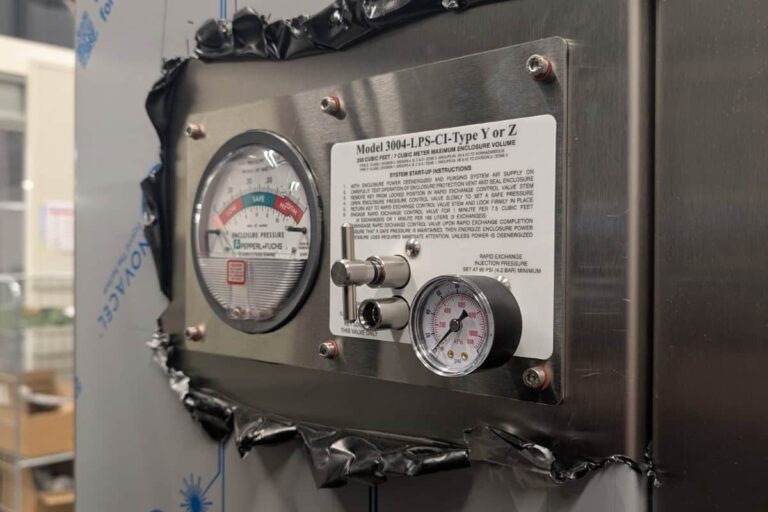
Although overpressure systems are less complex than purge systems, monitoring is still important for reliability.
Consider:
- control of fan operation
- signaling of clogged filter
- pressure loss detection
Without monitoring, anomalies often become apparent only when failures occur.
Integration into existing installations
In many situations, overpressure systems are used in existing switchboards. This requires a careful assessment of the current construction.
Key points of interest are:
- sealing of the existing cabinet
- available space for airflow
- compatibility with existing components
Adjustments without this analysis often result in systems that work in theory but fall short in practice.
Start your project with a technical consultation
We like to think with you from the initial design phase to realization and commissioning.
Related articles
ATEX zone 1 vs. zone 2: what does it mean for your control cabinet?
Within industrial environments where explosion hazards are present, ATEX zones are often used. Yet in practice we see that the
Overpressure in control cabinets: 5 common mistakes
In many industrial facilities, overpressure is used in a control cabinet to prevent contamination, moisture and harmful external influences. Consider
When is a purge system mandatory?
In industrial environments where explosion hazards are present, overpressure in switchboards is often discussed. In practice, confusion frequently arises here:
Frequently asked questions about Overpressure control cabinet: design and operation
What is a positive pressure switch box?
A positive pressure switchgear cabinet is a cabinet in which a slight positive pressure is created with filtered air to prevent contaminated or moist ambient air from entering.
When do you need an overpressure system?
When a switchgear cabinet is used in an environment with dust, moisture or contamination that may affect the reliability of electrical components.
What is the difference between overpressure and ventilation?
With ventilation, air is passively changed, often unfiltered. With positive pressure, air is actively filtered and supplied in a controlled manner, keeping contaminants out of the cabinet.
When is overpressure not enough?
At high thermal loads or in explosive environments. In these cases, additional cooling or a purge system is necessary.
How do you prevent condensation in a control cabinet?
By controlled air flows, limiting temperature differences and preventing the ingress of moist air, possibly in combination with heating or dehumidification.
