In industrial environments where explosion hazards are present, overpressure in switchboards is often discussed. In practice, confusion frequently arises here: when is standard overpressure sufficient, and when is a purge system mandatory?
This confusion is not without risk. Misapplication of a protection method can lead to unsafe situations, rejection during inspections or downtime of installations. Especially in ATEX environments, it is essential to make the right choice from the start.
Table of Contents
What is a purge system and when is it applied?
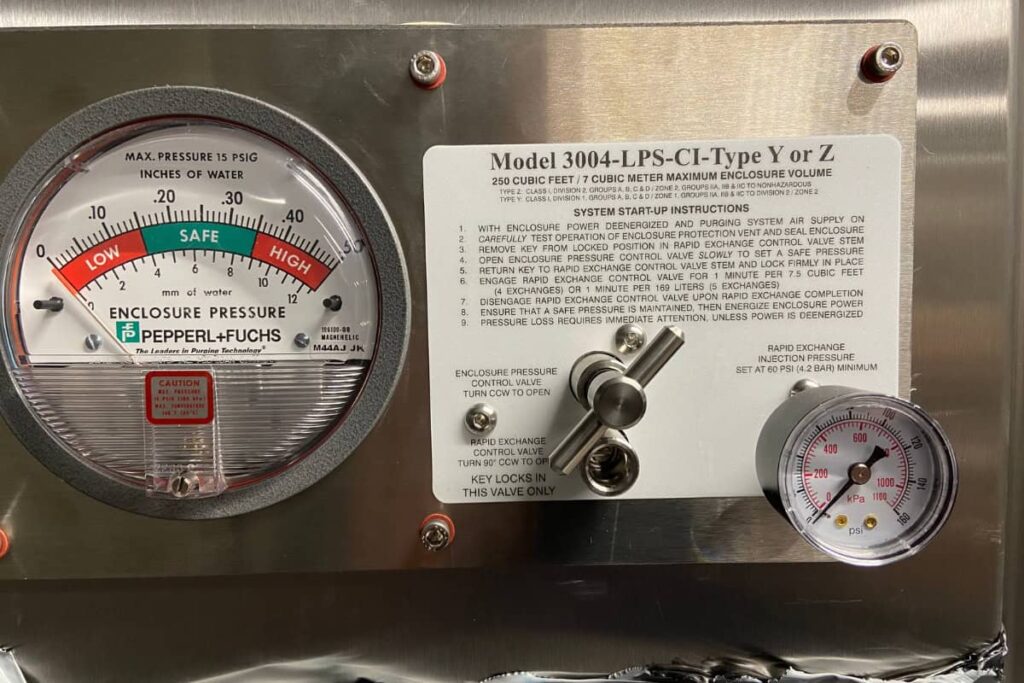
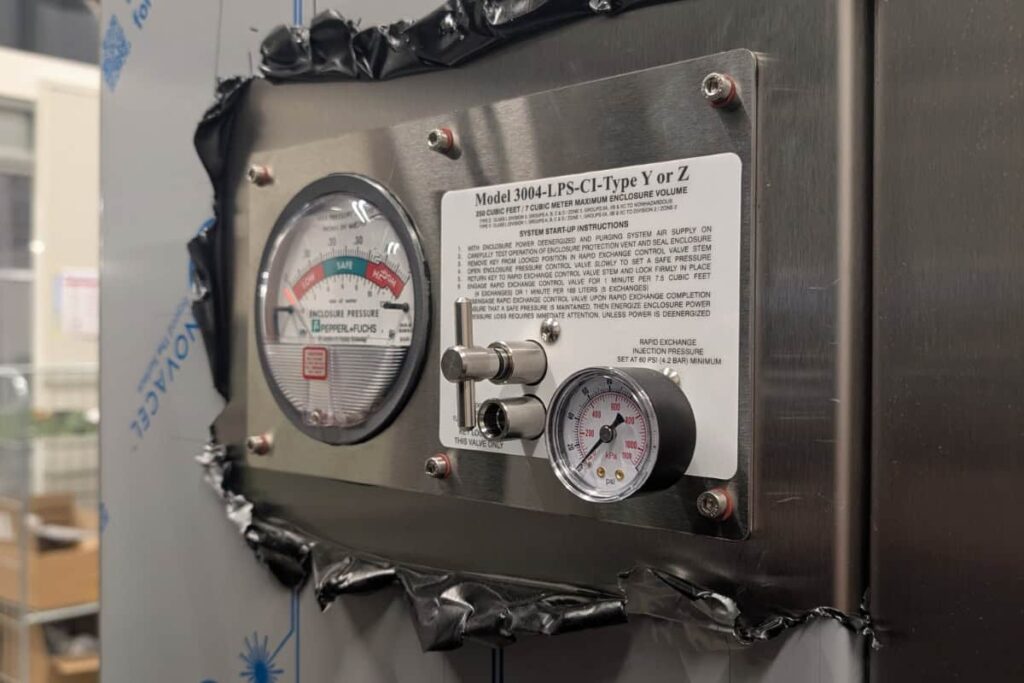
A purge system, also known as Ex p (internal overpressure), is a protection method in which a switchgear cabinet is actively kept at overpressure to prevent an explosive atmosphere from entering the cabinet.
The system works in two stages:
- first, the cabinet is “purged” (flushed) to remove any hazardous gases or vapors present
- then a constant overpressure is maintained
This allows standard, non-ATEX certified components to be used safely within an explosive environment, provided the system complies with applicable standards.
Important distinction: a purge system is not a simple ventilation solution. It is a controlled and monitored system with requirements around pressure, monitoring and fail-safe behavior.
OPEN CALCULATION
OFFER IN 5 DAYS
SUSTAINABLE INNOVATIONS
UL/CSA
IN HOUSE
When is a purge system mandatory?
A purge system is mandatory when a switchgear cabinet with non-explosion-proof components is used in an environment where an explosive atmosphere may occur.
This follows from the ATEX directives (such as ATEX 114) and associated standards for explosive atmospheres. The key question is always: Can an explosive mixture of gas, vapor or dust occur around or near the cabinet?
When standard overpressure is no longer sufficient
In practice, you see that standard overpressure or ventilation is sometimes used in situations where it is not permitted.
A purge system is usually required when:
- the installation is located in an ATEX zone 1 or zone 2
- there is a gas, vapor or dust explosion hazard
- the control cabinet contains standard components (such as PLCs, relays or variable speed drives) that are not ATEX certified
- the cabinet must remain closed and not be fully explosion proof (e.g. Ex d or Ex e)
In these situations, there is a risk of an explosive atmosphere entering the cabinet and coming into contact with ignition sources in the electronics. A purge system prevents this by keeping the cabinet continuously under controlled overpressure.
Applying only ventilation, filters or light overpressure is not sufficient in this context and does not meet the standard.
Common misunderstandings in practice
In projects, we frequently see that the decision to purge is made too late or incorrectly. This ties in with common mistakes made with overpressure in control cabinets.
A common thought is that a properly sealed cabinet with overpressure is “safe enough.” In reality, this offers no guarantee in an ATEX environment because there is no controlled purge phase and no continuous monitoring of pressure.
Zone 2 is also frequently underestimated. Although the chance of an explosive atmosphere there is smaller than in Zone 1, this does not mean that standard solutions are automatically allowed. Standardization remains leading.
In addition, fully explosion-proof components are sometimes chosen to avoid purge. This can be a valid choice, but is often costly and limited in flexibility. In many cases, a purge system is actually the technically and economically better solution.
Finally, existing installations frequently lack monitoring. Without pressure monitoring or detection, there is no assurance that the system is functioning as intended, even though this is a core requirement within Ex p applications.
Contact our experienced innovator
Cees Brasser
With more than 26 years of experience at the helm of Kwadrant IA, Cees Brasser is your expert on panel construction for the mechanical engineering sector. Discover how his knowledge and insight can take your project to new heights. Get in touch now!
How do you determine if purge is necessary for your switchgear?
Choosing a purge system always begins with a proper analysis of the environment and application.
Important factors are:
- The zone classification of the installation (e.g., zone 1 or 2)
- the presence of gas, vapor or dust
- the components used in the control cabinet
- The degree of sealing and construction of the housing
- the requirements from standardization and certification
On this basis, it is determined whether:
- standard overpressure is sufficient
- additional measures are needed
- Whether a full purge system is required
In many cases, this is not a black-and-white choice. It requires a combination of engineering, standards knowledge and practical experience.
If you want to look at this in more detail, read our page on overpressure and purge systems for control cabinets how these systems are applied and designed in practice.
Conclusion
A purge system is mandatory as soon as a control cabinet with standard components is used in a hazardous area and there is a risk that an explosive atmosphere could enter the cabinet.
The main pitfall is underestimating that risk and applying standard positive pressure or ventilation where a certified system is required.
By making the right choice early in the design process and considering standards, environment and application, you avoid problems during inspection and use.
If you are unsure whether your situation requires a purge system, it is wise to have it technically assessed before building or modifying the system.